
It is Monday morning and your calendar looks healthy. Twelve appointments, three new weight-loss consults, a couple of B12 regulars, an afternoon drip. By noon four chairs are empty. The reminders went out. You can see them in your software, each marked “sent,” so you blame the patients and the no-show rate everyone complains about. What you never suspect is that half those “sent” reminders never lit up a phone. A carrier filter dropped them before they rang, and you paid for software that talked to a wall.
Here is the honest answer up front: your clinic’s texts are not arriving because US carriers now block business texting that is not registered through a system called 10DLC, and health-related messaging gets filtered harder than almost any other kind. “Sent” in your software does not mean “delivered” to the phone. The fix is a one-time registration of your business and your message types with The Campaign Registry, real written consent on your forms, and a few habits that keep your number trusted.
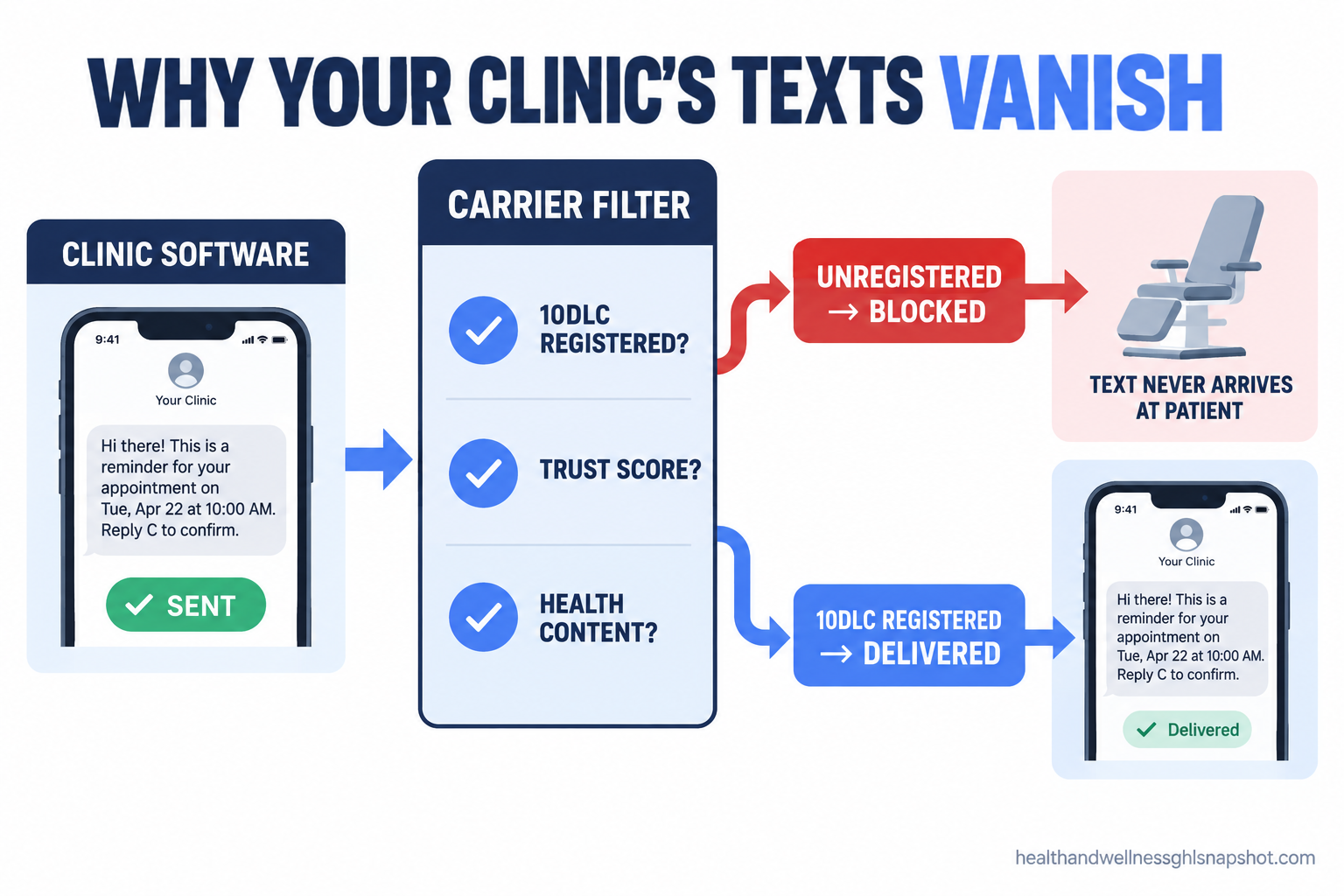
Table of contents
- What silent SMS filtering is costing your clinic
- Why clinic texts get filtered when retail texts sail through
- The 10DLC setup, one stage at a time
- Toll-free, short code, or 10DLC: which one your clinic needs
- Run it for your size: solo, three locations, high volume
- Steal this: the consent and auto-reply copy
- The compliance lines: TCPA, HIPAA, and health content
- Common objections, answered honestly
- Related reading
- Frequently asked questions
What silent SMS filtering is costing your clinic
Carrier filtering is invisible. A hard failure would tell you something broke; filtering just makes the message vanish, still marked “sent,” so your dashboard looks fine while your chairs sit empty. Run the math. Say your average appointment is worth $150. If filtering causes one reminded patient to no-show each day, that is roughly 250 a year, about $37,500 of booked time lost on messages you already paid to send.
No-show rate with and without an SMS reminder. A meta-analysis of 26 studies found reminded patients about 25% less likely to miss, near 15% against 21%. Source: Robotham et al., systematic review (PubMed).
That effect only exists if the text reaches the phone, which is why an unregistered clinic quietly loses money.
Why clinic texts get filtered when retail texts sail through
Your phone gets two kinds of text. One is a person typing to you. The other is a business sending the same message to a list, application to person, or A2P. Carriers treat A2P as its own category and built a gate in front of it, because that is where spam and scams live.
That gate is 10DLC, short for 10-digit long code, the ordinary local number most clinics text from. To push A2P traffic through it, carriers require the number to be registered with The Campaign Registry, a central database AT&T, T-Mobile, and Verizon all read from. Carriers phased this in across 2021 and 2022, and unregistered traffic today gets throttled or blocked.
Wellness clinics catch a second layer of scrutiny. Carriers filter on content and complaint rates, and on anything matching the categories they police, known as SHAFT: sex, hate, alcohol, firearms, and tobacco, with cannabis and CBD folded in. A clinic is nowhere near most of that, but the edges catch you. Naming a specific drug, especially a weight-loss drug, can trip a filter. Results-driven marketing language reads like the health claims carriers distrust. Generic public link shorteners look like what a scammer uses. One provider allows weight-loss drug mentions on 10DLC only for transactional content like reminders, not marketing blasts (ClickSend); CBD is prohibited outright regardless of state law (Telnyx).
The honest read: what gets you filtered is being unregistered, a low trust score, drug names and claims in the copy, and a shared link shortener. Fix those four and your texts behave.
The 10DLC setup, one stage at a time
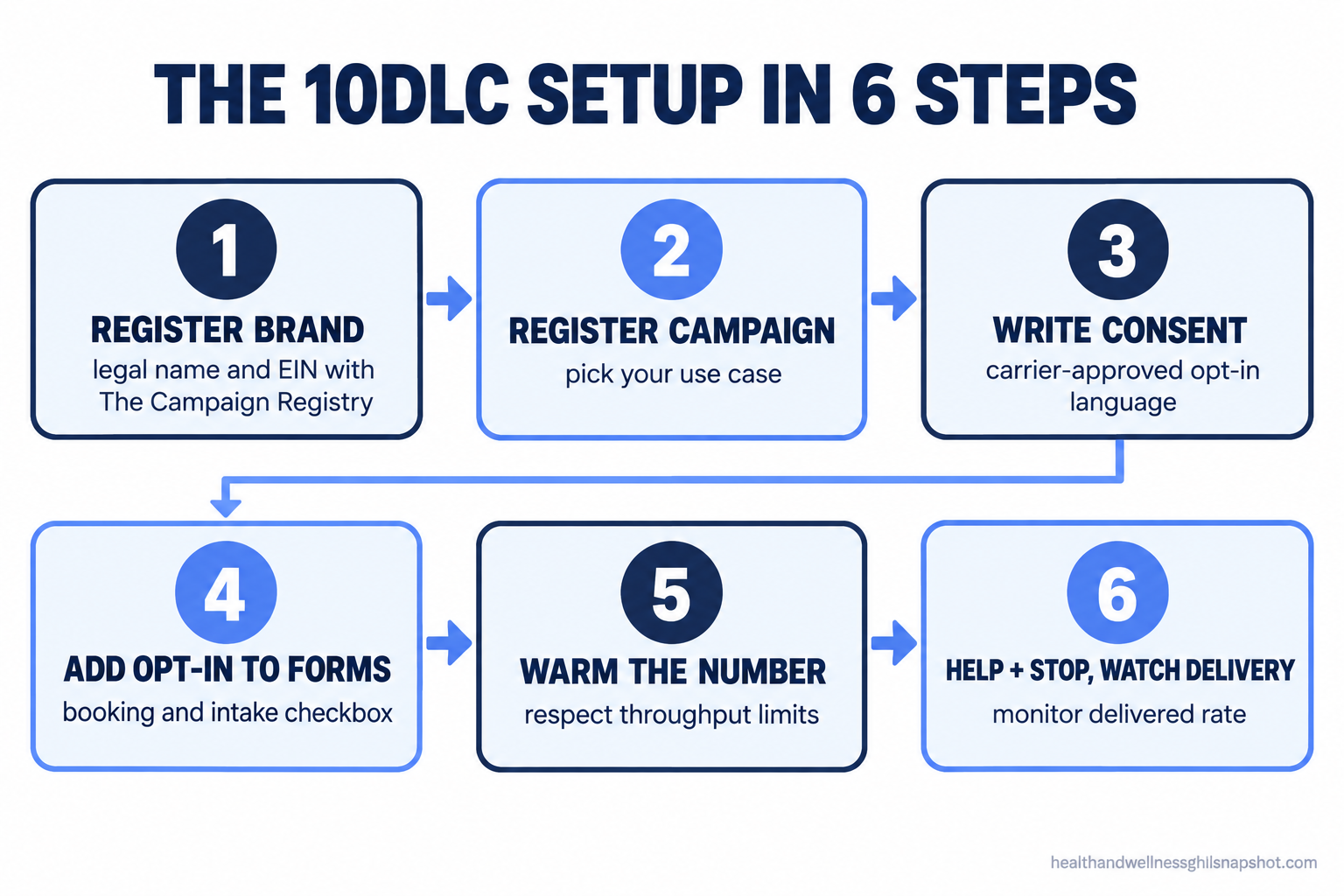
Registration sounds like a chore, but a short one. Here is the whole path, in order, inside GoHighLevel or any tool on Twilio underneath.
Stage 1: Register your business as a brand
Carriers first want to know who you are. You create a Brand with your legal business name, EIN, and address, exactly as they appear on your tax documents, and The Campaign Registry checks them and assigns a trust score that decides how much you can send.
The most common failure is a name mismatch. If your EIN says “Vital Drip Wellness LLC” and you type “Vital Drip,” the registration bounces and you lose days, so copy your IRS paperwork character for character. A sole proprietor with no EIN can use the sole-proprietor path, but it carries the lowest limits. In GoHighLevel the brand step is a form, and the platform submits it for you (GoHighLevel A2P fees).
Stage 2: Register each message type as a campaign
A brand says who you are. A campaign says what you send and how people agreed to get it. You pick a use case, describe the messages, give a sample, and explain how people opt in, opt out, and what HELP returns.
One campaign covering reminders and account notifications is enough for most clinics to start. If you also run promotional blasts, keep those as a separate campaign, because mixing a marketing offer into a reminder campaign is a classic rejection trigger. Describe the real flow: “patients opt in on our booking and intake forms, receive reminders and care follow-ups, and can reply STOP anytime.” Concrete descriptions get approved where vague ones get rejected, and resubmitting costs no extra vetting fee.
Stage 3: Write consent language the carriers will approve
Carriers do not take your word that patients opted in. They want to see the language, and it must state what messages you send, that frequency varies, that message and data rates may apply, and how to get help and stop. Missing any piece is why a lot of clinic campaigns stall.
The consent line is not legal theater. A rising opt-out rate makes carriers start filtering you, so clean consent keeps delivery high. The exact wording to lift is in the steal-this section below.
Stage 4: Put the opt-in on your booking and intake forms
Consent language only counts if a patient saw it and agreed, which means a real checkbox on the forms they already fill out: booking, intake, new-patient paperwork. The box must not be pre-ticked, and texting must not be a condition of booking care.
This is where clinics quietly break their own compliance. Importing an old list of numbers you collected before you had this language, then texting it, is not consented contact, and it spikes complaints fast. Going forward, every number enters through a form that carries the consent line, so your proof is built in. Automate intake and the form goes out the moment someone books, capturing the opt-in on its own (paperless, HIPAA-aware intake).
Stage 5: Warm the number and respect your throughput limit
A brand-new number is not trusted at full volume on day one, so start steady and let it build a reputation over a week or two instead of blasting the whole database the first afternoon.
Throughput is the hard ceiling, and it scales with your trust score. On T-Mobile, a brand scored 75 to 100 can send 200,000 messages a day, while a brand scored 1 to 24 is capped at 2,000, and a sole proprietor near 1,000 (Twilio, T-Mobile daily limits). Those limits are shared across every number under your business, so a three-location clinic draws from one pool. Most single clinics never touch the ceiling, but a high-volume weight-loss practice can, and hitting the cap means messages fail for the rest of the day.
Daily A2P message limit to T-Mobile numbers by 10DLC brand trust score. Limits are set at the business (EIN) level and shared across your numbers. Source: Twilio, T-Mobile daily message limits for A2P 10DLC.
Stage 6: Wire up HELP and STOP, then watch your delivery reports
Two keywords are mandatory. HELP must return who you are and how to reach a human. STOP must unsubscribe the person and stop every message, and many networks enforce it automatically (CTIA best practices, via Bandwidth). Honor it instantly; a single ignored STOP is the kind of complaint that drags your whole brand down.
Then look at your delivery reports, the step clinics skip. Watch the delivered rate, not the sent rate. If delivered sits well below sent, you have a filtering problem to chase: a pending registration, a flagged link, or a drug name in your copy.
Toll-free, short code, or 10DLC: which one your clinic needs
Owners often ask whether toll-free is an easier door. The honest comparison:
| 10DLC (local number) | Toll-free | Short code | |
|---|---|---|---|
| Looks like | A normal local number | An 800/888-style number | A 5 to 6 digit number |
| Registration | Brand + campaign with The Campaign Registry | Toll-free verification (now required) | Heavy application, carrier approval |
| Best for | Most clinics, two-way texting | Backup or higher single-number volume | Big brands, huge volume |
| Two-way conversation | Yes, feels personal | Yes | Usually one-way |
| Cost to start | Low, passthrough fees | Low | High, hundreds a month plus setup |
| The catch | Must register to get delivery | Unverified toll-free is now blocked too | Overkill for a clinic |
The headline most people miss: toll-free is not a loophole. Since late 2023, carriers block messaging from unverified toll-free numbers entirely (Twilio changelog), so toll-free needs registration too, just a different form. For nearly every IV bar, hormone practice, or weight-loss clinic, a registered 10DLC local number is the right answer: a real local look, two-way texting, and the cheapest path to delivery.
Run it for your size: solo, three locations, high volume
The registration is the same shape for everyone, but the choices around it change with your size.
The solo RN IV bar. You text a few dozen reminders a week. Register as a proper business if you have an EIN, pick one standard campaign, and wire the consent line into your booking form. Your volume is nowhere near a throughput ceiling, so your only real job is clean consent and watching the delivered rate. The one-time setup in GoHighLevel for a low-volume standard brand runs about $22.50 passthrough, with a small monthly campaign fee after (GoHighLevel A2P fees).
The two-to-three-location hormone or weight-loss clinic. You have more numbers and message types, and the throughput pool is shared across all of them under one EIN. Register one brand, keep transactional reminders and promotional sends as separate campaigns, standardize one consent line across every location’s forms, and watch the daily cap as your member base grows.
The high-volume weight-loss or GLP-1 clinic. Weekly injection check-ins to a few thousand members is real A2P volume, and exactly the content carriers scrutinize most. Earn the highest trust score you can, which may mean external brand vetting, and keep strict discipline in the copy: no drug names in bulk messages, no results claims, logistics only. At this scale a filtering problem is thousands of check-ins failing silently, so delivery monitoring is not optional.
Steal this: the consent and auto-reply copy
None of the copy below makes a clinical claim or names a drug. It is the compliance wrapper that keeps your channel healthy. Adjust the bracketed details and capture the opt-in first.
Opt-in language for your booking and intake forms (the line reviewers look for):
By providing your mobile number, you agree to receive appointment reminders, care follow-ups, and account messages from [Clinic Name] at the number provided. Message frequency varies. Message and data rates may apply. Reply HELP for help and STOP to opt out. Consent is not a condition of purchase.
Privacy-policy SMS clause (carriers specifically check for this):
[Clinic Name] does not sell, rent, or share mobile opt-in data or SMS consent with third parties for marketing purposes. Phone numbers collected for text messaging are used only to send messages from our clinic.
HELP auto-reply:
[Clinic Name]: appointment and care messages. Msg frequency varies. Msg and data rates may apply. Reply STOP to cancel. Help: [phone] or [email].
Appointment reminder (transactional, safe, no claim):
Hi [name], this is [Clinic]. Reminder of your visit on [date] at [time]. Reply C to confirm or R to reschedule, or call [phone]. Reply STOP to opt out.
Rebooking or recall nudge (keep it logistics, never a promise):
Hi [name], it’s [Clinic]. You’re due to book your next visit whenever you’re ready. Grab a time here: [link]. Reply STOP to opt out.
One rule makes all of this land: use a branded short link, never a generic public shortener, and keep every message to logistics so nothing reads like a health claim.
The compliance lines: TCPA, HIPAA, and health content
Getting delivery right does not get the legal part off your plate. Three lines to respect.
TCPA and consent. You still need prior express written consent for marketing texts, captured through the opt-in language above. The FCC’s “one-to-one consent” rule, set to take effect in January 2025, was vacated by the Eleventh Circuit before it ever did (Morrison Foerster) and formally eliminated by the FCC later in 2025 (Goodwin). Do not read that as “consent is optional.” It is not, and your campaign gets rejected without it.
HIPAA is not automatic. If your clinic bills insurance or shares protected health information with covered partners like labs or referring physicians, you are a covered entity, and your texting needs a business associate agreement with your software vendor. A pure cash-pay IV bar may fall outside HIPAA, but you still owe state privacy and breach-notification duties, so never assume the exemption. Keep protected details out of the text; a reminder needs a time and a place, not a diagnosis. More in HIPAA-aware SMS for wellness practices.
Common objections, answered honestly
“My texts send fine. I can see ‘sent’ in GoHighLevel.” Sent is not delivered. Carriers drop filtered A2P traffic silently, and the platform still logs it as sent. You find out from your no-show rate, not an error. Watch the delivered rate instead.
“Isn’t 10DLC GoHighLevel’s job to handle?” The platform gives you the pipe and the form, and submits your details to The Campaign Registry for you (step-by-step guide). But you are the brand. Only you can provide your legal name, EIN, and proof of how patients consent.
“I’m cash-pay, so HIPAA doesn’t apply and I can text whatever.” Carrier rules are not HIPAA. 10DLC and TCPA apply whether or not you are a covered entity, and health-adjacent content is filtered hardest of all.
Related reading
- HIPAA-aware SMS for wellness practices
- Missed-call text-back: turn every missed call into a booked client
- How to reduce appointment no-shows at your wellness practice
- What no-shows actually cost your wellness clinic
- Automate paperless, HIPAA-aware client intake
Frequently asked questions
What is 10DLC and does my clinic actually need it?
10DLC means 10-digit long code, the ordinary local number most clinics text from. Carriers require business texting on these numbers to be registered through The Campaign Registry, in two parts: a Brand for your business and a Campaign for each message type. If you send any automated text from a local number, you need it, or carriers filter and block your messages.
Why do my appointment reminders show as 'sent' but never arrive?
Because 'sent' only means the message left your software. If your number is unregistered, carries a low trust score, or trips a content filter, the carrier drops it before it reaches the phone, usually with no bounce, while your platform still logs it as sent. Watch the delivered rate, not the sent rate.
How much does 10DLC registration cost for a small clinic?
In GoHighLevel the fees are passthrough with no markup. A low-volume standard registration bundles to about $22.50 one-time, with a monthly campaign fee of roughly $1.50 to $10 by use case, and about $15 per additional campaign. The figures are in GoHighLevel's A2P fee documentation and can change, so confirm them in your account.
Does 10DLC apply if I only send reminders, not marketing?
Yes. Any application-to-person texting from a business, including purely transactional reminders, falls under 10DLC and must be registered. The upside is that reminders and care follow-ups are a clean, legitimate use case that registers easily when your consent and opt-out handling are in place.
Can weight-loss or GLP-1 messages get my number blocked?
They can raise your filtering risk. Carriers scrutinize health content, so naming a specific drug or using results-driven marketing language in a bulk text can trip a filter. Transactional reminders are generally fine. Keep drug names and claims out of automated copy, use a branded link, not a public shortener, and keep bulk messaging to logistics.