
It is 11:50am on a Tuesday. You are in a treatment room placing a line, your front-desk person is on hold with a supplier, and the clinic phone rings three times and drops to voicemail. The caller was a woman who saw your Instagram, wanted to book a NAD+ drip for Saturday, and had her card out. She does not leave a message. She calls the clinic two miles away instead, gets a human, and books there. You never knew she existed. That is not a marketing problem. That is a front-desk problem, and it is costing you more than any ad you are running.
Here is the honest answer up front: the fastest profit lever in a wellness clinic is not a new offer, it is a front desk that says the right thing, fast, every time. Most clinics lose money in six predictable conversations, the new-lead call, the missed call, the no-show, the price question, the one-and-done rebook, and the cancellation. Give your desk a word-for-word script for each, answer new inquiries in minutes not hours, and move the follow-up to text, and you recover revenue you already paid to attract. This guide gives you all six scripts to steal, the timing that makes them work, and the quiet ways each one breaks.
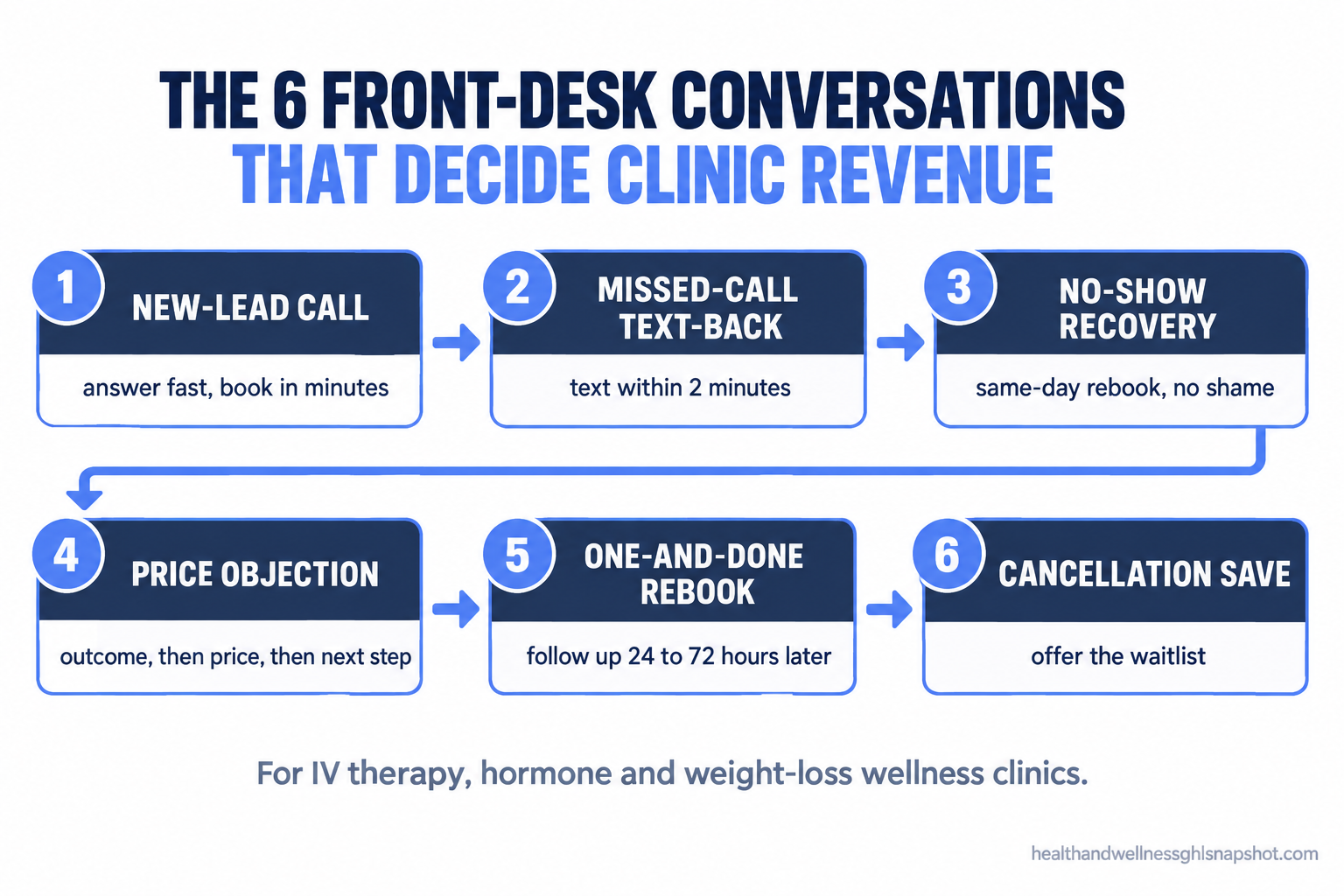
Table of contents
- Why a script beats a nice personality
- The six conversations that decide your revenue
- Script 1: the new-lead call (and the missed-call text-back)
- Script 2: the no-show same-day recovery
- Script 3: the price objection
- Script 4: the one-and-done rebook
- Script 5: the cancellation save
- Script 6: the review request
- Run it three ways: solo, two-person desk, three locations
- The compliance lines your scripts must respect
- Objections, answered honestly
- Frequently asked questions
Why a script beats a nice personality
Owners think their front desk is fine because the staff are friendly. Friendly is not the problem. A friendly person under pressure improvises, and improvisation loses the same money every time: the price question answered with a flat number, the no-show that gets a shrug instead of a text, the voicemail nobody returns until tomorrow.
The money at stake is large and mostly repeat business. The average medical spa location brought in about $1,398,833 in 2024, up from $1,307,587 the year before (AmSpa, 2024), return clients make up roughly 70% of med spa visits (AmSpa), and the IV hydration market is growing toward $3.0 billion in 2026 at a 9.2% CAGR (Grand View Research). Your front desk is the gate every one of those dollars walks through, and the gate is only as good as the sentences it says.
Speed is the part owners underrate most. In an audit of 2,241 US companies, firms that reached a new lead within an hour were nearly 7 times more likely to have a real conversation with a decision maker than firms that waited one more hour, and more than 60 times more likely than those who waited a day (HBR, 2011). A wellness lead is deciding on a whim with a card in hand, and will book whoever answers first.
Relative likelihood of qualifying a new lead by first-response time (1 hour vs 24+ hours), from an audit of 2,241 US companies. Source: Harvard Business Review, 2011. The decay is steepest in the first hour.
The six conversations that decide your revenue
You do not need a hundred scripts. You need six, because six conversations carry almost all of the lost money in a small wellness clinic. Here they are, in the order a client runs into them, with the job each one has to do.
| Conversation | When it happens | The job of the script |
|---|---|---|
| 1. New-lead call | A stranger calls or DMs to book | Answer fast, qualify, book or text back in minutes |
| 2. No-show recovery | Same day, after a missed slot | Rebook without shame, keep the relationship |
| 3. Price objection | “How much is a drip?” | Frame the outcome, give the price, offer the next step |
| 4. One-and-done rebook | 24 to 72 hours after a first visit | Turn a single visit into a return or a member |
| 5. Cancellation save | A client cancels or reschedules | Offer the waitlist, hold the revenue |
| 6. Review request | After a good visit | Earn a public review while it is fresh |
Every script below follows the same shape so your team can learn them fast: what to say, when to say it, and the one way it quietly breaks. Keep them on a one-page card at the desk and saved as text snippets in your system.
Script 1: the new-lead call (and the missed-call text-back)
This is the conversation that pays for everything else. A new caller is deciding in real time. Answer live if you possibly can, qualify in three questions, and book before you hang up.
When you cannot answer live, the rule is simple: never let a missed call sit silent. An automatic text back within two minutes recovers the booking, because the caller has not moved on yet. Our full breakdown of missed-call text-back for wellness clinics covers the setup, but here is the message.
How it breaks: the call goes to a voicemail nobody checks until the next morning, and by then the caller booked elsewhere. Most people will not leave a voicemail at all, and a majority of Americans do not even answer calls from unknown numbers (Pew Research Center), which is exactly why the text-back, not the callback, is the save. The second failure is over-qualifying: asking ten intake questions on a cold call. Get the booking first. Intake happens after they are on the calendar.
Script 2: the no-show same-day recovery
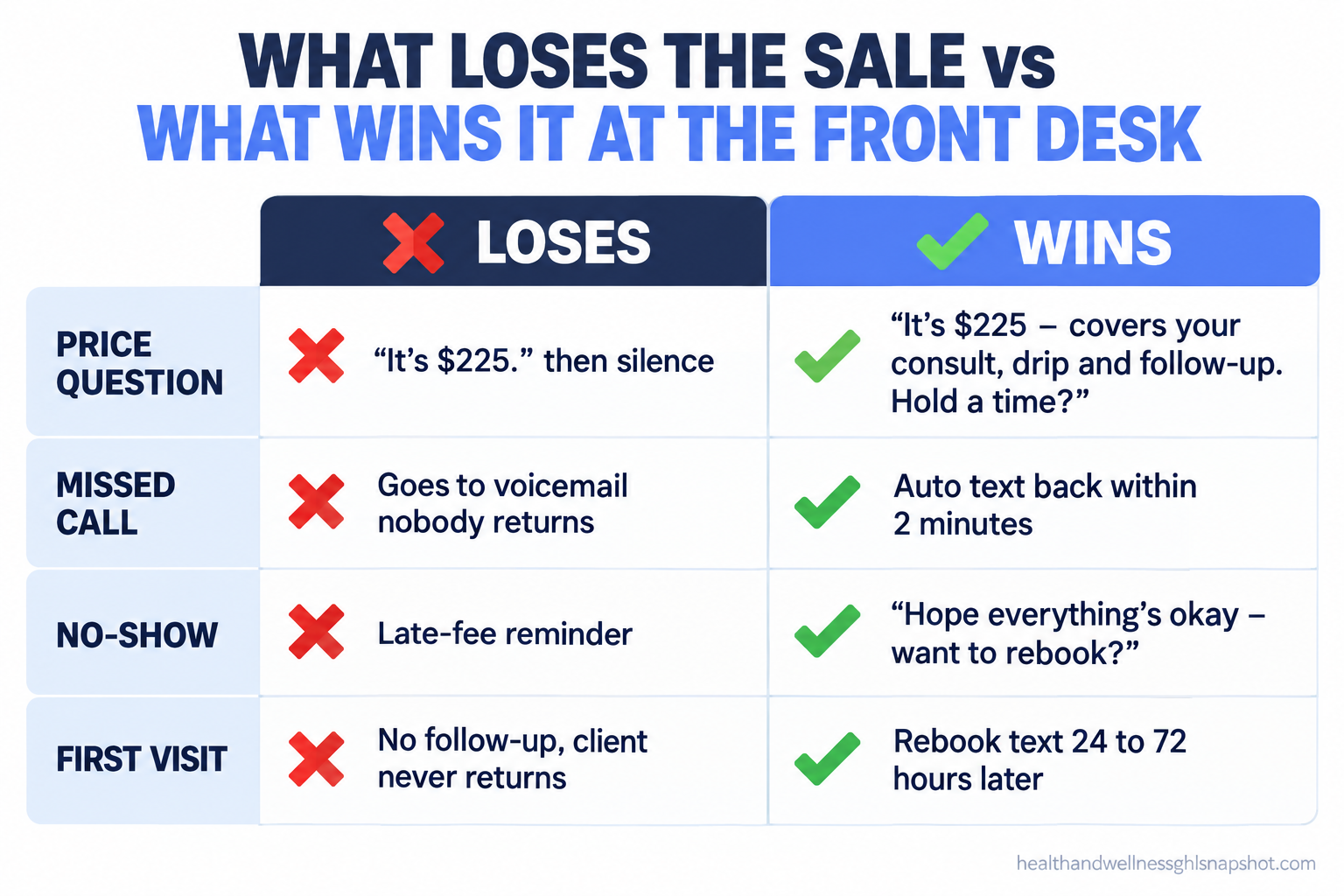
No-shows are not flaking, they are forgetting. And they are not going away: in an MGMA poll from August 2025, 27% of practices said no-shows had risen that year, while 60% said they were flat (MGMA, 2025). A no-show at an IV or injectable clinic is expensive because the supplies were prepped and the room and staff were paid for anyway. The full math is in what no-shows actually cost your clinic. The recovery script has one job: rebook without making the client feel judged, because shame makes people ghost you permanently.
How it breaks: two ways. First, the guilt tone. “You missed your appointment and there is a fee” ends the relationship for a $200 client who would have happily rebooked. Lead with concern, not a penalty. Second, waiting too long. A no-show texted the same hour often rebooks the same week. A no-show you call three days later is gone. If you charge a late-cancel fee, that is a separate policy conversation set at booking, not the first thing you say after a miss. For a complete reminder cadence that prevents the no-show in the first place, see how to reduce appointment no-shows.
Script 3: the price objection
“How much is it?” is the question that makes untrained front desks panic. They either blurt a number and go quiet, or they dodge. Both lose the sale. A price question is a buying signal. The person is interested enough to care what it costs. Your job is to wrap the number in an outcome and immediately offer the next step, so the price never hangs in the air alone.
How it breaks: the naked number. “It’s $225.” Silence. The client says “okay, let me think about it,” and never calls back, because you gave them a price with nothing to weigh it against. The second failure is apologizing for your pricing, which teaches the client your service is not worth it. Say the number plainly, tie it to the outcome, and move to the booking. Never discount on the first ask. If you want a soft landing, offer a single visit instead of a package, not a lower price.
Script 4: the one-and-done rebook
This is the single biggest leak in an IV or injectable clinic. A client comes once, has a great visit, and you never hear from them again, not because they were unhappy but because nobody asked them back. With return clients making up 70% of med spa visits (AmSpa), the second booking is where the business actually lives. We dug into why IV clients only come once separately, but the fix starts with one text 24 to 72 hours after the first visit.
How it breaks: the timing and the ask. Send it a week later and the moment is cold. Send it the same afternoon and it feels transactional. The 24-to-72-hour window is when they still feel the visit and have not gotten busy again. The second failure is overselling the membership on visit one. Offer the next single visit first, mention the membership as the easier option, and let them choose. If you want the full post-visit sequence that converts single visits into recurring revenue, we laid it out in turn one-time IV clients into members.
Script 5: the cancellation save
A cancellation is not automatically lost revenue. It is an open slot you can refill and a client you can reschedule, if your desk treats it as a save instead of a shrug. The instinct is to say “no problem, bye.” The better move is to reschedule in the same breath and, if you keep a waitlist, offer the slot to the next person.
How it breaks: letting the cancellation end as a cancellation. Every “okay, no problem” that does not include a reschedule offer is a slot you will scramble to fill and a client who now has no next visit on the books. The waitlist half only works if you are actually capturing a waitlist, which is a front-desk habit, not a feature. If you keep a simple list of who wanted an earlier time, a canceled slot becomes someone else’s booking in minutes.
Script 6: the review request
A string of recent five-star reviews is the cheapest marketing a local clinic has, and the best time to ask is the hour after a client walks out happy. Ask too broadly and you collect nothing. Ask one specific person right after a great visit and you get the review.
How it breaks: asking everyone, or asking late. A blast to your whole list a month after the fact gets ignored. A specific text to someone who just had a good experience gets a review. Do not incentivize reviews with discounts, which violates most platforms’ terms and the FTC’s rules on endorsements. Just ask, kindly, at the right moment, and make the link one tap.
Run it three ways: solo, two-person desk, three locations
The scripts do not change. Who says them, and how much is automated, changes with your size. Here is how the same six conversations run at three real stages of a clinic.
Solo operator (you are the front desk). You cannot answer the phone with a line in someone’s arm, so automation is your front desk, not a luxury. The non-negotiables: an automatic missed-call text-back, plus no-show and rebook texts triggered off your calendar so they fire without you. You handle the price objection and the live new-lead call when you can. The one-and-done leak hurts most here, because you have no slack to chase anyone by hand.
Two-person desk. The risk now is inconsistency: two people answering the same question two different ways, one great on the phone and one who freezes on price. Put the one-page script card at the desk, automate the texts so they never depend on who remembered, and shift your job to coaching: listen to a few calls a week and tighten the one script your team keeps fumbling.
Three locations (team plus a VA). The scripts have to be identical everywhere or your brand feels different depending on which number a client dials. Centralize the text snippets and automations so every site sends the same messages, and route overflow calls to one shared virtual assistant working from the same card. The failure mode is drift: one location quietly stops sending the rebook text and nobody notices for a quarter, because the numbers only sag a little. Audit that the automations fire, per location, monthly. If your desk is simply underwater, see why the front desk can’t keep up.
The compliance lines your scripts must respect
Texting a client is not the same as texting a friend, especially in health. Three rules decide whether your scripts are an asset or a liability.
Consent and opt-out (TCPA and 10DLC). You need prior express consent before texting a client anything promotional, and marketing-style texts need a clear opt-out like “Reply STOP.” Health messaging draws heavier carrier filtering, so your business number should be registered under 10DLC or messages quietly fail to deliver. Capture consent at booking, keep a record, and honor STOP instantly. The setup is in our HIPAA-aware SMS guide.
Keep protected health information out of the text body. A reminder can say “your visit at [Clinic Name] on Thursday.” It should not spell out a diagnosis, medication, or lab result. Whether or not your cash-pay clinic is formally covered by HIPAA (a pure cash-pay IV bar billing no insurance may fall outside it, yet still owes state privacy and breach duties), keep clinical detail out of SMS.
No outcome promises in the script. The FTC has warned hundreds of weight-loss and wellness marketers and sent letters to IV-therapy companies over immune claims, so your front-desk language cannot promise results. “Boosts your immune system” or “melts fat” is a claim you must substantiate, and most clinics cannot. Train the desk to describe the service, not a health outcome: “a lot of clients come in for hydration and energy,” not “this will cure your fatigue.”
Objections, answered honestly
“Won’t scripts make my front desk sound robotic?” Only if you read them like a hostage note. A script is a backbone, not a cage. Your team says the key lines the same way every time (the price frame, the rebook offer) and stays human around them. Pure improvisation is what actually sounds bad, because it is different and worse every single call.
“My staff won’t follow a script.” They will if it is one page, not a binder, and if you show them the money. Pull one month of missed calls and no-shows, put a dollar figure on them, and the script stops being bureaucracy. Coach one conversation at a time. Anyone can learn the price reframe this week.
“Won’t automated texts annoy clients?” The opposite, when they are useful and consented. A majority of people say texting is how they want businesses to reach them (Zipwhip via Business Wire, 2021). What annoys people is a call they have to pick up or a voicemail to return. A short text they answer on their own time is a courtesy, as long as you honor STOP.
“Isn’t this too impersonal for healthcare?” The personal part is the care you give in the room. The scripts cover the logistics around it, the booking, the reminder, the rebook, which clients want handled fast and predictably. Getting the logistics right is what frees you to be present during the visit.
Frequently asked questions
What is the single most important front-desk script for a new clinic?
The missed-call text-back. Most callers will not leave a voicemail, so an automatic text within two minutes of a missed call recovers bookings you would otherwise lose to the clinic that answered first. Firms that respond within an hour are about 7 times more likely to qualify a lead, and a two-minute text beats that easily.
How quickly should the front desk respond to a new lead?
Within minutes, not hours. A wellness lead is often deciding on impulse with a card in hand and will book whoever answers first. If you cannot answer live, an automated text-back buys you time to follow up without losing the booking.
How do I answer the price question without scaring people off?
Never give a naked number. Frame the outcome first, state the price plainly, then offer to hold a time. If it is more than they expected, offer a single first visit rather than discounting a package. A price question is a buying signal, so treat it as interest.
What should the front desk say after a no-show?
Lead with concern, not a penalty. A same-day text like "we missed you today, hope everything's okay, want me to get you back on the calendar?" rebooks far more clients than a fee reminder. Any late-cancel fee is set at booking, not after a miss. See what no-shows actually cost.
Can I text clients health reminders without breaking the rules?
Yes, with consent and care. Capture express consent at booking, register your number under 10DLC, include an opt-out on promotional texts, honor STOP instantly, and keep clinical detail out of the text body. Our HIPAA-aware SMS guide covers the consent language.
How do I keep scripts consistent across multiple locations?
Centralize them. Store the snippets and automations in one system so every site sends identical messages, keep a one-page card at each desk, and audit monthly that the automations fire per location. Drift is the main risk: one site quietly stops sending a text and revenue sags before anyone notices.
Back to that Tuesday at 11:50am. Run the same scene with the scripts in place. The call still drops to voicemail while you are placing the line, but two minutes later a text goes out on its own: “Sorry we missed you, were you hoping to book? I can get you in this week.” By the time you have finished in the room, the caller has replied with a day, your desk has her on the calendar, and the clinic two miles away never got the chance. Nothing about your medicine changed. You just stopped losing the conversations you were already paying to start. Pick one script this week, the missed-call text-back, and get it live. Then add the next.