It’s 7:15 p.m. in San Antonio. A woman who has been putting off her weight-loss consult for months finally taps “call” on your practice from her phone. She’s more comfortable in Spanish than English. Your line rings to voicemail — you’re closed, or with a client — and the outgoing greeting is in English. She doesn’t leave a message. She taps back to the map, finds a clinic whose profile says “se habla español,” and books there instead. You never learn her name, and you never knew she was lost.
In a city where nearly two-thirds of residents are Hispanic, a wellness practice that answers the phone in English only — or doesn’t answer after hours at all — is quietly turning away a huge share of its market. A bilingual AI receptionist is a 24/7 voice agent that greets callers in English or Spanish, qualifies them, and books the consult directly into your calendar, so the Spanish-speaking clients your competitors miss become the clients you keep. This is the honest, sourced picture of the language gap in San Antonio, what it costs, and how the fix actually works. Every statistic below carries its source, and the caveats are called out throughout.
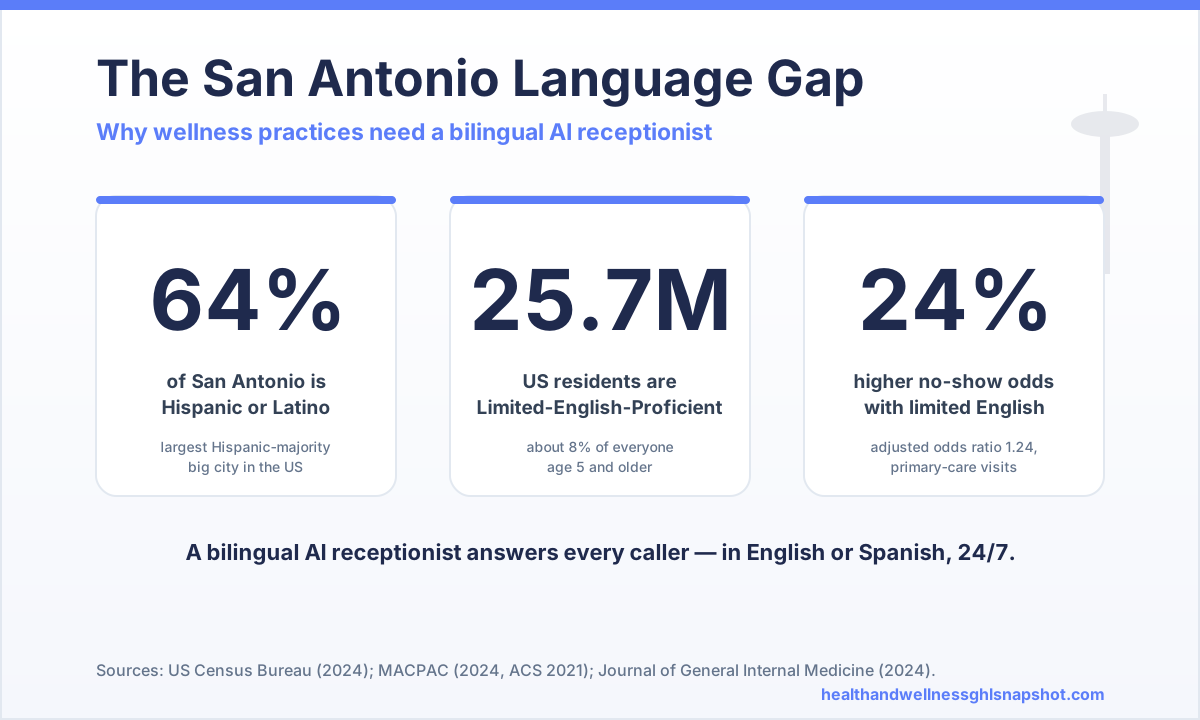
Table of contents
- The language gap San Antonio practices don’t see
- What the phone gap actually costs your practice
- Why a callback or a bilingual staffer scramble isn’t enough
- What a bilingual AI receptionist is, and how it works
- Bilingual AI receptionist vs the alternatives
- Language access, HIPAA, and TCPA: staying conservative
- What to look for in a bilingual AI receptionist
- Frequently asked questions
The language gap San Antonio practices don’t see
San Antonio is not a market where “English is fine” quietly holds true — it is the largest Hispanic-majority major city in the country, and a first phone call is exactly the moment language comfort matters most. About 64% of San Antonio residents are Hispanic or Latino (U.S. Census Bureau QuickFacts, 2024), and roughly 75% of US Latinos say they can carry on a conversation in Spanish “pretty well” or “very well” (Pew Research Center, 2023). Many of those clients are perfectly bilingual — but when someone is nervous about a hormone panel, a weight-loss program, or their gut-health symptoms, they reach for the language they think in.
Zoom out and the pattern is national, not local. Roughly 25.7 million US residents — about 8% of everyone age 5 and older — are Limited English Proficient (MACPAC, 2024, analyzing ACS 2021 data), and Spanish is by a wide margin the most common language other than English spoken at home in the US, with well over 40 million speakers (U.S. Census Bureau, 2022). In a city like San Antonio, that national baseline is concentrated: the share of your prospective clients who would prefer — or need — to start in Spanish is far higher than the practice down the street assumes.
Here’s the part most wellness owners never see: the loss is invisible. An English-only voicemail doesn’t generate an angry review. The caller simply hangs up and books elsewhere, and your call log shows a missed call with no name attached. You don’t lose these clients because you’re a worse practitioner — you lose them because the very first interaction told them, quietly, that your practice wasn’t built for them.
The US language landscape, in millions of residents age 5+. Sources: U.S. Census Bureau, 2022 (language spoken at home); MACPAC, 2024 (Limited English Proficient).
What the phone gap actually costs your practice
The cost of a missed or mishandled call isn’t the call — it’s the lifetime value of the client behind it, multiplied by how often it happens, and language friction makes it happen more. Wellness relationships are long: a nutrition client on a multi-month package, a hormone patient on quarterly retests, or a weight-loss member on a recurring program can represent well over a thousand dollars across the engagement. Lose one ready-to-book Spanish-speaking caller a week to an English-only voicemail, and the annual number gets uncomfortable fast.
The friction is measurable even after someone becomes a patient. In a 2024 study at an urban safety-net system, patients with limited English proficiency had 24% higher adjusted odds of a primary-care no-show (aOR 1.24; 95% CI 1.12–1.37) than English-proficient patients (Journal of General Internal Medicine, 2024). When reminders, instructions, and scheduling all happen in a language a client is straining to follow, appointments slip — and every empty slot is revenue you can’t get back.
The point isn’t to guilt you into answering your phone bilingually at 9 p.m. It’s to show that a system that answers for you, in the caller’s language, pays for itself off a single recovered client a month.
Why a callback or a bilingual staffer scramble isn’t enough
Speed to lead — the time between a prospect reaching out and you responding — is one of the highest-leverage numbers in a practice, and both language friction and after-hours calls make it brutal. The classic research is blunt: you’re up to 100× more likely to contact a new lead, and 21× more likely to qualify them, when you respond within 5 minutes versus 30 minutes (MIT Lead Response Management study, 2007). A voicemail you return tomorrow morning — after you’ve found someone on staff who can call back in Spanish — is competing against a clinic that answered, in the right language, on the first ring.
The two obvious “fixes” both break down:
- “We’ll call them back.” After hours, the caller has already moved on. During the day, the callback still has to be routed to whoever on your team is comfortable in Spanish — which usually means it doesn’t happen fast, or doesn’t happen at all.
- “Our front desk speaks some Spanish.” Helpful during office hours, but they go home, take lunch, and get overwhelmed at exactly the busy moments calls pile up. And leaning on an untrained bilingual staffer or a family member to interpret is genuinely risky: ad-hoc, untrained interpreters omit or mistranslate a large share of clinically significant information, while trained interpretation improves quality and outcomes (Flores systematic review, via PubMed).
When you do reconnect, text is where the conversation actually continues. SMS is widely reported to carry roughly a 98% open rate and about a 45% response rate, versus roughly 20% and 6% for email (Gartner, 2023). A bilingual AI receptionist wins the first five minutes on voice, in the caller’s language, then keeps the thread alive over the channel people actually reply to.
Average response rate by channel (%). Source: Gartner, 2023.
This is the same logic behind missed-call text-back for wellness practices and the broader speed-to-lead playbook — a bilingual AI receptionist is the version that also answers the phone, in English or Spanish, before the text ever has to fire.
What a bilingual AI receptionist is, and how it works
A bilingual AI receptionist is a natural-voice AI agent that answers your practice’s phone around the clock, detects or asks whether the caller prefers English or Spanish, greets them in that language in your brand’s tone, qualifies them, checks your live calendar, and books the consult — then logs the whole interaction to the client record. It is not a robotic phone tree (“marque uno para español”). It holds a real conversation on either side of the language line and never sends a motivated new client to a language they’re straining to use.
Here’s what happens from the moment a San Antonio prospect dials your number:
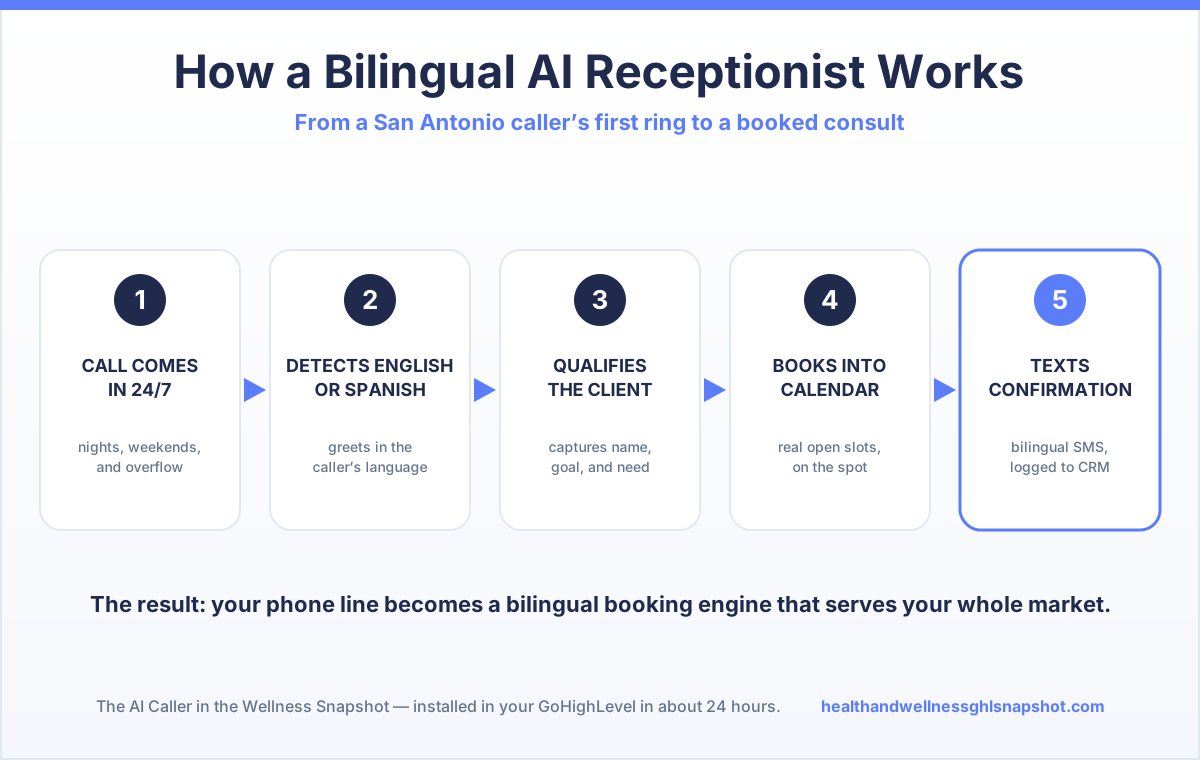
- A call comes in — 24/7. Daytime overflow, a 9 p.m. inquiry, a Sunday-morning “¿tienen citas disponibles?” — every call is answered on the first or second ring instead of rolling to an English-only voicemail.
- It meets the caller in their language. The AI greets in English or Spanish (and can switch mid-call), answers approved questions about your programs and hours, and puts a nervous first-time caller at ease.
- It qualifies and captures the essentials. Name, goal, and what they’re looking for — logged consistently, in whatever language the caller used.
- It checks your live calendar and books. Instead of “someone will call you back,” the AI offers real open slots and books the consult directly, while the caller is still motivated.
- It confirms by SMS. A text confirmation lands immediately, in the caller’s language, with reminders scheduled to cut the no-shows that language friction otherwise drives up.
- Everything is logged and handed off. The full interaction is written to the CRM, so your team picks up with context — and knows this client prefers Spanish — instead of starting cold.
The result: your phone line stops being a leak and starts being a booking engine that serves your whole market, not just the English-speaking half of it.
Bilingual AI receptionist vs the alternatives
Most San Antonio practices default to voicemail, lean on an English-first front desk, patch in an interpreter line, or try to hire bilingual staff — each of which trades one problem for another. Here’s how the options actually compare for a wellness practice serving a bilingual market:
| Capability | English-only voicemail | English-first front desk | Interpreter line | Bilingual AI receptionist |
|---|---|---|---|---|
| Answers 24/7 (nights, weekends) | Records only | No — office hours only | Only if staff dials in | Yes, always |
| Greets callers in Spanish instantly | No | Sometimes | After a wait/transfer | Yes, on the first ring |
| Books directly into your calendar | No | Yes | No | Yes, instantly |
| Knows your programs & script | No | Yes | No — generic | Yes, trained on you |
| Consistent, logged interaction | No | Manual | Rarely | Yes, automatically |
| Scales with call volume | N/A | Hire more people | Per-minute fees | Handles spikes flat |
| Typical ongoing cost | Free (and costly) | Salary + benefits | Per-minute | Flat, predictable |
Voicemail is free and expensive — it “works” and loses you Spanish-speaking clients at the same time. An English-first front desk is invaluable during office hours but goes home, and after-hours is when a huge share of high-intent wellness calls actually land. An interpreter line solves comprehension but adds a wait and doesn’t book anything. A bilingual AI receptionist covers the gap none of the others do: it’s on at 9 p.m. and on Sundays, it meets the caller in their language on the first ring, it’s trained on your offer, and its cost doesn’t spike when you get busy.
If you’d rather not run any of it yourself, a dedicated wellness VA can operate the whole system for you — or you can have our team build and customize the automation around your existing tools.
Language access, HIPAA, and TCPA: staying conservative
Language access isn’t just a marketing edge in San Antonio — it’s also the direction regulation is moving, which is one more reason to build the first touch right. Under Section 1557 of the Affordable Care Act and Title VI of the Civil Rights Act, health programs and activities that receive federal financial assistance must take reasonable steps to provide meaningful access to people with limited English proficiency, free of charge (HHS Office for Civil Rights; 2024 Final Rule, Federal Register).
An honest caveat: many cash-pay wellness and coaching businesses are not “covered entities” under those rules, so this is best understood as the standard of care and the direction of the market — not a claim that every reader is legally bound. What it does mean is that meeting Spanish-speaking clients in their language is increasingly expected, and doing it through one consistent system beats improvising.
A few guardrails to hold yourself to, in either language:
- Consent first. Text callers on a TCPA-aware basis and make opt-out effortless (reply STOP / responde ALTO). The HIPAA-aware SMS guide walks through the specifics.
- Keep PHI out of plain channels. The receptionist should collect name, goal, and scheduling — not diagnoses or sensitive health details over unencrypted SMS.
- You own the clinical claims. We are not a healthcare provider, and the automation does not diagnose, treat, or advise in any language. Your license, your HIPAA obligations, and your FTC health-claim compliance remain yours — the AI is your bilingual lead-capture and communication layer, nothing more.
Built this way, a bilingual AI receptionist reduces risk versus ad-hoc staff or a family member interpreting from a personal phone, because every interaction runs through one consistent, logged, consent-aware system.
What to look for in a bilingual AI receptionist
Not every “AI phone answering” tool is genuinely bilingual or built for a regulated, relationship-driven wellness practice. If you’re evaluating one for a San Antonio practice, insist on:
- True Spanish fluency, not a translated phone tree — the AI should converse naturally and switch languages mid-call.
- Real calendar booking, not just message-taking — the whole value is booking the consult while the caller is hot.
- Trained on your programs and tone, so it sounds like your front desk in either language.
- Bilingual SMS follow-up and missed-call recovery, because even the best system will have overflow moments.
- TCPA-aware messaging with quiet-hours and STOP/ALTO handling baked in.
- CRM logging and language preference captured, so your team continues with full context.
- A flat, predictable cost that doesn’t punish you for getting busy.
The phone line, before and after
Evening and weekend calls roll to an English-only voicemail. Spanish-preferring callers hang up without a message and book the next San Antonio clinic that says 'se habla español.' You never learn who called, and your no-show rate quietly runs higher.
Every call answered in one ring, 24/7, in English or Spanish. New clients qualified and booked into the calendar on the spot, confirmations texted in their language, and every interaction — including language preference — logged to the CRM for your team.
The AI Caller is one of 11 automation features in the Wellness Snapshot — a done-for-you GoHighLevel system installed in about 24 hours that you own outright. It answers the calls you can’t, in the languages your market actually speaks, so the clients your competitors miss become yours.
Frequently asked questions
Bilingual AI receptionist for San Antonio wellness practices — FAQ
What is a bilingual AI receptionist for a wellness practice?
It's a 24/7 natural-voice AI agent that answers your practice's phone, greets callers in English or Spanish, answers approved questions about your programs, qualifies the caller, and books the consult directly into your calendar — then logs the interaction and the caller's language preference to your CRM. It's built to capture lead and scheduling details, not clinical PHI in plain channels.
Why does this matter specifically in San Antonio?
San Antonio is about 64% Hispanic or Latino — the largest Hispanic-majority big city in the US (U.S. Census Bureau, 2024) — and roughly 75% of US Latinos can hold a conversation in Spanish (Pew Research Center, 2023). A practice that answers in English only, or not at all after hours, quietly turns away a large share of its market to competitors who greet callers in Spanish.
Does answering in Spanish really affect bookings and no-shows?
It affects both. Speed and language decide who wins the first call — you're up to 21× more likely to qualify a lead reached within 5 minutes versus 30 (MIT Lead Response Management, 2007). And after someone becomes a patient, limited English proficiency was associated with 24% higher adjusted odds of a primary-care no-show in a 2024 study (Journal of General Internal Medicine), because reminders and instructions in a strained language get missed.
Is a bilingual AI receptionist HIPAA- and TCPA-compliant?
A well-built one is designed to be conservative: it collects name, goal, and scheduling — not sensitive PHI over unencrypted channels — and its SMS respects quiet hours and honors STOP/ALTO opt-outs on a TCPA-aware basis. We are not a healthcare provider; your clinical claims, HIPAA obligations, and FTC compliance remain your responsibility. See our HIPAA-aware SMS guide for specifics.
Will it replace my front desk or bilingual staff?
No — it complements them. Your team is invaluable during office hours; the AI receptionist covers the nights, weekends, and overflow moments when calls would otherwise hit voicemail, and it removes the risky habit of asking an untrained staffer or family member to interpret. Together they mean no motivated caller goes unanswered in either language.
How fast can I get one running?
The AI Caller ships as feature #1 of 11 in the Wellness Snapshot, a done-for-you GoHighLevel system installed in about 24 hours. You can also book a free 30-minute demo to watch it answer and book a real consult in English and Spanish before you decide, or have a wellness VA run the whole system for you.
Written by Kwame Adeyemi, GHL Snapshot Engineer. Kwame builds and stress-tests the workflows that ship inside the Wellness Snapshot — including the AI Caller, its bilingual SMS recovery, and the consent gates behind them. He translates technical GoHighLevel mechanics into language a busy practitioner can act on. Kwame is a GoHighLevel automation specialist, not a licensed healthcare provider; nothing here is medical or legal advice.
Keep reading: AI Receptionist for Wellness Practices in Los Angeles · Missed-Call Text-Back for Wellness Practices · Speed to Lead: Why the First 5 Minutes Decide the Client · Reduce Appointment No-Shows