
It is the second week of the month and you are looking at your bank balance the way every cash-pay clinic owner does: hoping this month clears last month. Your IV bar was busy, your weight-loss injections moved, but the number resets to near zero on the first and you start the climb again. A membership would fix that, so you open your booking software to turn one on. The feature is there. It is just sitting one tier up, and switching adds a few hundred dollars a month to a bill you already resent.
Here is the honest answer up front: you do not need a premium software tier or a stack of paid add-ons to run a membership. A working membership is not a feature you buy, it is a seven-stage system you run: price it, sell it at the point of care, bill it on infrastructure you control, onboard the member, touch them monthly, recover the failed cards, and save the cancels. Stripe Billing charges about 0.7% on recurring payments on top of normal card fees (Stripe), so a $10,000 membership book costs roughly $70 a month to bill, not a few hundred. What is worth building once is the automation around it. This guide walks all seven stages, with the real text copy you can steal, how each one breaks, and the math for a solo, a three-location, and a larger clinic.
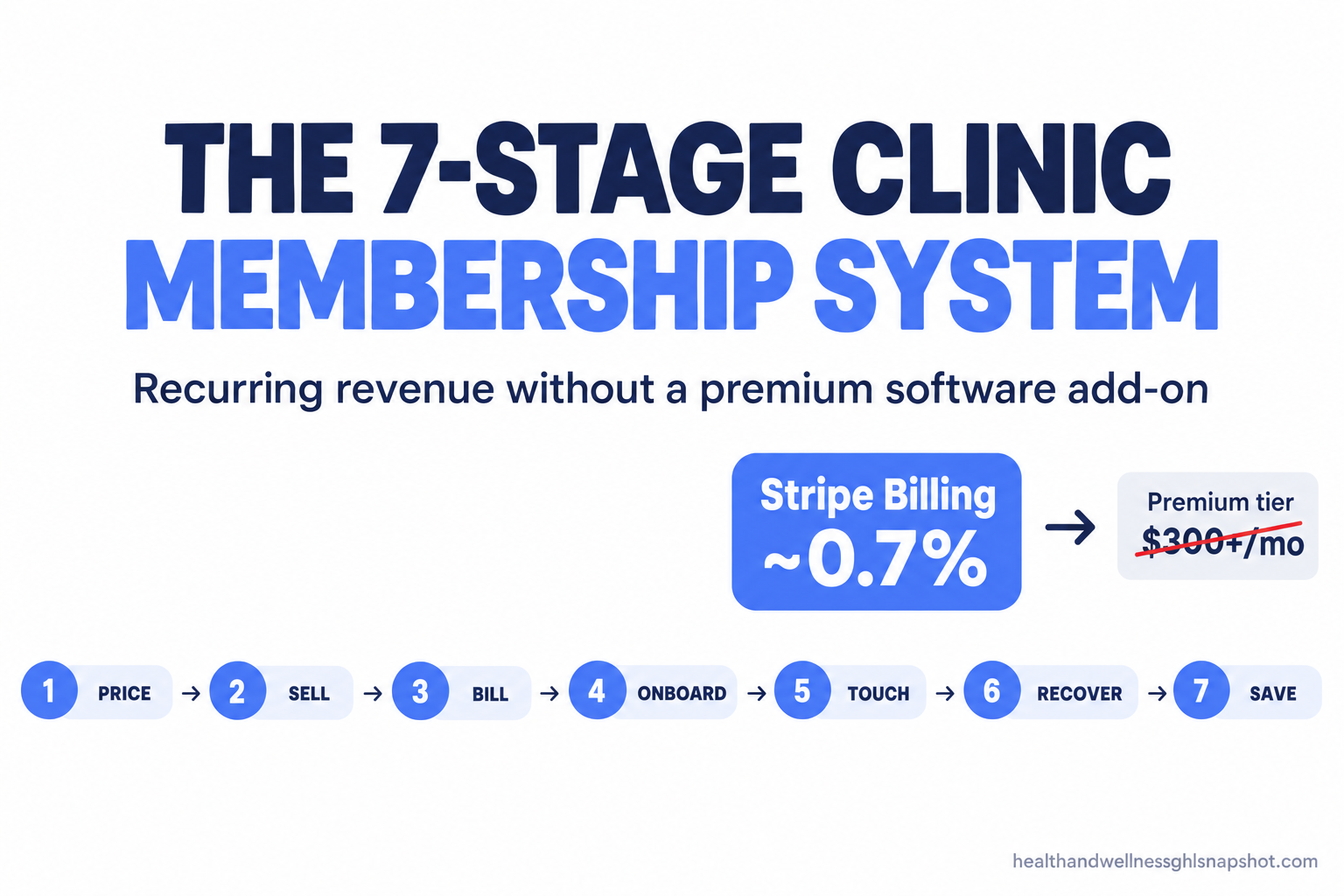
Table of contents
- Why a membership is the fix for one-and-done clients
- The add-on trap: what “membership” costs inside your software
- The seven-stage membership system
- What a solo, a three-location, and a larger clinic each run
- The compliance rules a membership actually triggers
- Common objections, answered honestly
- Frequently asked questions
Why a membership is the fix for one-and-done clients
The problem with a cash-pay clinic is not demand, it is memory. A client comes in for a hydration drip or a first weight-loss injection, feels great, means to come back, and then life happens and they do not. Nothing asked them to return, so they did not. You covered that exact failure in why IV therapy clients only come once. A membership solves it structurally: the client pre-commits, and the billing keeps happening whether or not anyone remembers to send an invoice.
Your best revenue is already in the room. AmSpa reports return patients account for roughly 70% of med spa visits (AmSpa), with the average location generating about $1,398,833 in 2024, up from $1,307,587 in 2023 (AmSpa). The IV hydration segment alone is projected near $3.0 billion in 2026 at a 9.2% CAGR (Grand View Research). The owners winning that market are the ones who turned walk-ins into monthly members and stopped starting from zero every first. A membership makes revenue predictable, raises lifetime value, and lowers what you pay to re-acquire the same people. The only thing in your way is the belief that it takes expensive software. It does not.
The add-on trap: what “membership” costs inside your software
Here is the nuance most people get wrong: the membership button is usually already in your software. What costs money is everything that makes a membership actually retain. As our breakdown of what med spa software costs in 2026 shows, the base plan looks reasonable, then the pieces you need to run the program well sit a tier up or as paid add-ons. Boulevard offers memberships natively, but its med-spa-capable tiers run about Premier $263 to Prestige $410 per location per month, with text marketing and its Forms and Charts (about $65/mo) as paid extras on lower tiers (Capterra). Zenoti is quote-only at a reported $300 to $600 per location per month (Capterra). Mangomint, by contrast, now includes memberships in its base $120-per-location plan (Mangomint), which proves the feature was never worth a premium tax.
None of that is a scandal, those are real booking and point-of-sale products. The trap is assuming the membership billing and retention automation have to live inside that stack. They do not. Stripe Billing charges about 0.7% on recurring payments on top of the standard 2.9% plus $0.30 card fee (Stripe). On a $10,000 monthly book, that is about $70 a month, not a premium tier upgrade. The gap is never the billing. It is the automation that keeps members enrolled, and that is the part you build once and own.
Illustrative monthly software cost to run a $10,000/mo membership book, before card processing. Premium tiers shown at their per-location monthly rate; Stripe Billing at 0.7% of the book. Sources: Stripe Billing, Capterra (Boulevard), Capterra (Zenoti). “Owned platform” shows marginal monthly cost; the build is a one-time cost.
Before you upgrade a tier for memberships, ask the rep in writing which features need the next tier and what the monthly difference is for your locations. If the answer is a few hundred dollars a month mostly for recurring billing plus a few emails, you are paying a premium for something Stripe does for 0.7%. Keep your booking tool for booking, and move the membership program to infrastructure you control.
The seven-stage membership system
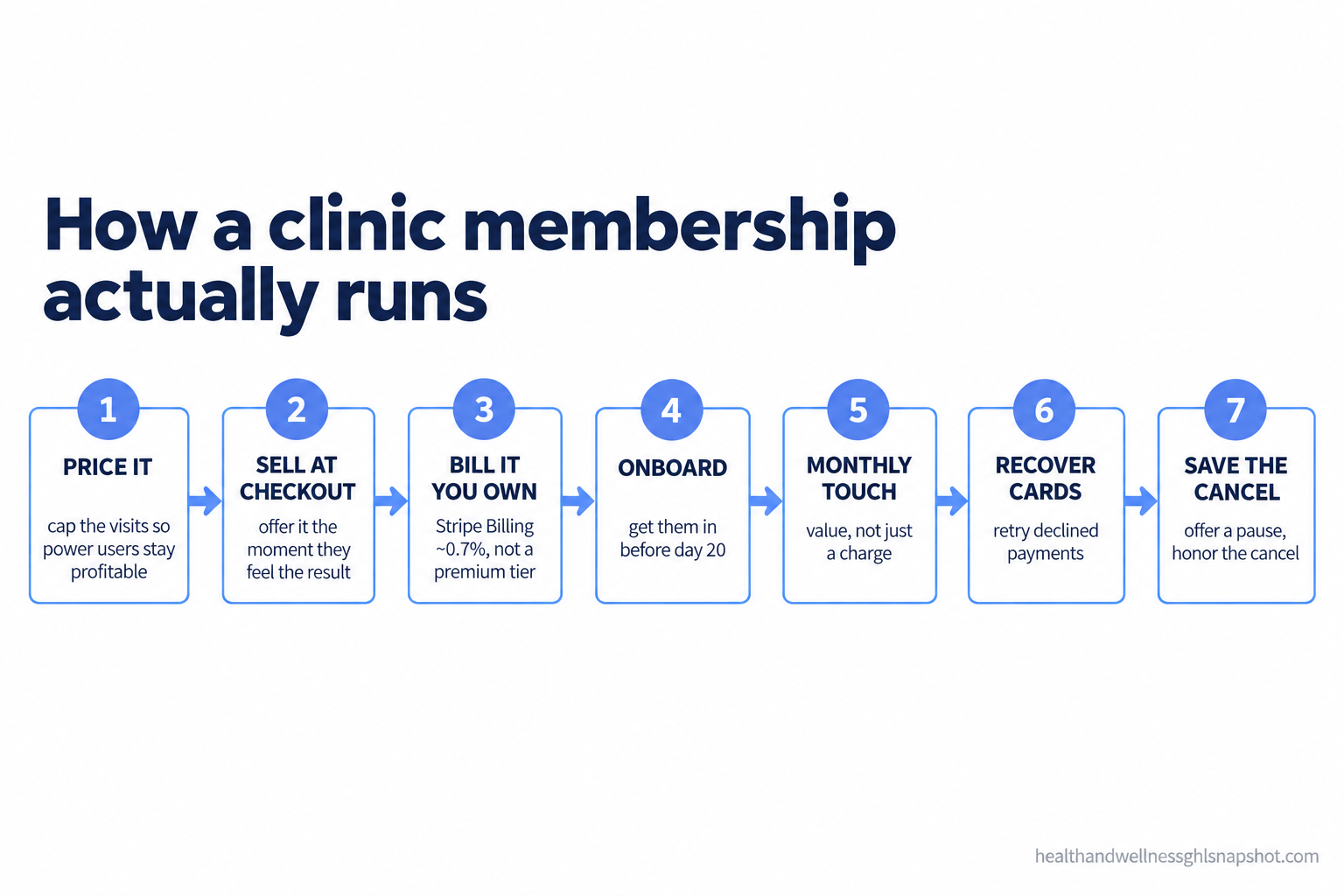
A membership that grows is seven stages working together. Miss the pricing and the margin dies; miss the recovery and declined cards quietly cancel your best members. Below is each stage, the real copy where it applies, and the way it breaks.
Stage 1: Price it so the margin survives
Start from cost and desired margin, not from a competitor’s number. Add your consumables, nursing time, room time, and a fair slice of fixed cost per visit, then decide how many visits the membership includes and price so a fully-using member still leaves you a margin. We go deep on the models in how to price wellness coaching packages, and the same math applies to injectables and drips.
How it breaks: you discount a monthly membership below single-visit pricing without capping usage, your most enthusiastic members come three times a month, and you lose money on the people who love you most. Cap the visits or raise the price. A membership that bleeds on power users is not a membership, it is a coupon.
Stage 2: Sell it at the point of care, not in an email later
The best time to enroll a member is the moment they feel the result, standing at your front desk. Do not save the pitch for a newsletter. Train the desk to offer it at checkout after a great first visit, and back it with one automated message a day later while the feeling is fresh. The offer is simple: the thing you just paid for, cheaper and automatic, every month.
How it breaks: you rely on the desk to remember, they get busy, and the pitch happens maybe one visit in five. Automate the day-after text so it goes out every time, then let a human close the replies. People plus automation beats either alone.
Stage 3: Bill it on infrastructure you own
This is the stage vendors want you to think is hard. It is not. Set up a recurring plan in Stripe Billing (or your platform’s built-in billing), store the card on file with consent, and let it charge on a fixed date. Stripe’s recurring fee is about 0.7% on top of the base card rate (Stripe), so cost scales with your book instead of a flat monthly tax. Then connect the billing events to your automation platform so a successful charge, a failed charge, and a cancellation each fire the right message. That connection is the whole trick, and it is a one-time build.
How it breaks: you set up billing but wire nothing to the events, so a failed card silently stops paying and you find out sixty days later. Every billing event needs to fire an automation. A charge that fails in silence is a member you lost without a fight.
Stage 4: Onboard the new member in the first 30 days
A member who does not use the membership in month one cancels in month two. The first thirty days set the habit. Send a warm welcome the moment billing succeeds, tell them exactly how to book, and make sure they come in before day 20. A member who has been in twice feels the value; one who paid and never returned only feels the charge.
How it breaks: the welcome goes out, then nothing, and the member forgets they joined until the second charge surprises them. Silence in month one reads as “they forgot about me.” Program the day-12 nudge and you turn a forgotten charge into a booked visit.
Stage 5: Give them a reason to open the text every month
Recurring revenue is a relationship, and relationships need a monthly touch that is not a bill. Once a month, tell the member their credit is ready, remind them of a member-only perk, or share something useful. Your name should show up in their phone attached to value, not just a charge. This is the retention muscle behind the 21-day renewal pre-warm, on a monthly loop.
How it breaks: the only time the member hears from you is when the card is charged, so the membership feels like something they forgot to cancel. Land the value touch before the charge, not after, and the charge feels earned instead of sneaky.
Stage 6: Recover the failed cards before they become cancellations
A large share of membership cancellations are not decisions, they are declined cards. Cards expire, get reissued after fraud, or bounce on a hold, and if nothing chases the failure, the member is gone without ever choosing to leave. Recurly’s research shows failed payments are a leading, recoverable cause of churn (Recurly). We built the full sequence in failed payment recovery for wellness memberships; the short version is retry on a schedule and text the member kindly, not like a collections agency.
How it breaks: you treat a decline as a cancellation and cut access immediately, so a loyal member with an expired card gets locked out and feels punished. Retry first, ask second, restrict last.
Stage 7: Save the cancel, and learn from the ones you lose
A cancellation request is a conversation, not a form submission. When a member asks to cancel, respond like a human, offer a pause instead of a full cancel, and ask one question about why. A pause keeps the relationship warm and often becomes a return. Honor the cancel promptly either way, because it is right and because auto-renewal laws require it (more below).
How it breaks: you make canceling hard or slow, the member gets annoyed, and a quiet churn becomes a public one-star review about being trapped. Easy to cancel is not just compliant, it is how you earn the win-back later.
What a solo, a three-location, and a larger clinic each run
The seven stages are the same at every size. What changes is the scale of the billing and how much you automate versus staff.
Illustrative annual membership revenue by clinic size (members multiplied by monthly fee, times twelve). Figures are examples to show scale, not guarantees.
Solo cash-pay IV bar or acupuncturist. You are the front desk and the provider. Keep it simple: one membership tier, Stripe Billing, and the day-after invite plus failed-payment recovery automated so you never chase money by hand. At 40 members paying $99, that is about $47,520 a year on roughly $28 a month of Stripe Billing fees. The automation replaces the staff you do not have.
Three-location RN or NP owned clinic. Now the risk is inconsistency: location three sells and recovers differently than location one. Standardize the seven stages so every location runs identical signup, billing, and recovery flows, and route responses to whoever is on the desk. At 180 members averaging $129, that is roughly $278,640 a year, and the failed-payment recovery alone protects real money at that volume. It is the retention plumbing behind our client retention benchmarks.
Larger med spa with a medical director. You likely keep a full EHR and point-of-sale for clinical and payment work, correctly. The question is whether the membership nurture, monthly touches, and recovery live inside that expensive stack or on a platform you own. At 250 members averaging $199, the book is near $597,000 a year, and a one or two point retention gain from better touches and recovery is worth more than the entire software bill. Own the layer that touches the member; keep renting the layer that charts the visit.
The compliance rules a membership actually triggers
A recurring charge is a regulated thing, and three rules apply the moment you turn one on.
Auto-renewal and negative-option law. You are enrolling people in a plan that charges until they cancel, a “negative option.” The FTC’s federal Click-to-Cancel rule was vacated by the Eighth Circuit in July 2025 and is not currently in force (Sidley), though the FTC may revisit it (FTC). That is not a green light. State auto-renewal laws, California’s among the strictest, still require clear disclosure before you charge, affirmative consent, and an easy way to cancel. Disclose the price and cadence at signup, get a real yes, make canceling easy. Stage 7 is compliance, not just kindness.
SMS consent and 10DLC. Every membership text is business messaging, which US carriers route through A2P 10DLC brand registration, and health-adjacent keywords draw heavier filtering (Twilio). Register your brand and campaign, capture explicit opt-in at signup, honor STOP instantly. Read HIPAA-aware SMS for wellness practices first, and let the consent gating in our SMS automation feature handle the opt-in and opt-out plumbing.
HIPAA is conditional, so do not assume the exemption. If your clinic bills insurance or shares protected health information with a covered entity like a lab or referring physician, you likely need a Business Associate Agreement with any tool that touches patient data (HHS). A pure cash-pay IV bar may sit outside federal HIPAA but still owes state privacy and breach-notification duties. Keep clinical detail out of marketing texts, and get the BAA in writing where it applies.
Common objections, answered honestly
“I already pay for Boulevard, so why bill outside it?” Keep Boulevard for booking and point-of-sale, those jobs stay put. The narrow question is whether the membership billing and automations justify jumping to a higher tier. If the tier costs a few hundred dollars a month mostly for recurring billing you can run at 0.7% elsewhere, you are paying a premium for a solved problem. Keep the clinical and POS system, move the membership layer to something cheaper or owned.
“Won’t members feel spammed by all these texts?” Not if the cadence is right. The system is one invite, one welcome, one nudge if they have not booked, one value touch a month, and messages only when a payment fails. That is the level of contact a member of a premium clinic expects, not spam. The spam risk comes from random blasts, not a tight sequence tied to real events, and every message carries an opt-out.
“Do I need to be technical to build this?” No, but someone has to wire the billing events to the automations once. That is the one genuinely technical step, and it is a build, not a daily task. After it is connected, the system runs itself and you manage exceptions. If that is not how you want to spend a weekend, that is what a done-for-you install is for.
“What if a member abuses an unlimited membership?” That is a Stage 1 pricing failure, not a reason to skip memberships. Cap included visits, or price the unlimited tier for heavy use, so a power user is still profitable. Most members never hit the cap; you just cannot let the few who would set fire to your margin.
The bottom line
Back to that bank balance that resets to zero on the first. A membership is how you stop starting over, and the thing in your way was never the software. Billing is cheap: Stripe moves the money for about 0.7%, and the automations that keep members are a one-time build, not a monthly tier. Run the seven stages, price it so the margin holds, sell it at the point of care, bill it on infrastructure you own, onboard hard in month one, touch the member monthly, recover the declined cards, and save the cancels with grace. Do that and next month does not reset to zero. To see the seven stages already built as a one-time install, book a quick demo and compare it against the tier upgrade your vendor is quoting.
Frequently asked questions
How much does it really cost to run a clinic membership program?
The billing is cheap. Stripe Billing charges about 0.7% on recurring payments on top of the standard 2.9% plus $0.30 card fee, so a $10,000 monthly membership book costs roughly $70 a month to bill. The real investment is the one-time setup of the retention automations, not a monthly software tier.
Do I need to upgrade my booking software to offer memberships?
Usually not. Some platforms include memberships natively; others push you to a higher tier or paid marketing add-ons. But recurring billing is a solved, inexpensive problem you can run on Stripe Billing or a platform you own once. Keep your booking tool for booking, and run the membership billing and nurture on cheaper infrastructure.
What causes members to cancel, and how do I stop it?
Two things: they stop using the membership, or their card silently fails. Fix the first with strong month-one onboarding and a monthly value touch. Fix the second with a retry schedule and a friendly payment-update text, since a large share of cancellations are just declined cards, not unhappy members.
Is it legal to auto-charge a membership every month?
Yes, if you follow negative-option and state auto-renewal law. The FTC's federal Click-to-Cancel rule was vacated in July 2025, but state auto-renewal laws (California's among the strictest) still require clear disclosure of price and cadence before you charge, real affirmative consent at signup, and an easy way to cancel.
Do membership texts need SMS consent registration?
Yes. Membership messages are business texting, which US carriers route through A2P 10DLC brand and campaign registration, and health-related messaging faces heavier filtering. Capture explicit opt-in at signup, honor STOP immediately, and register your brand before sending automated messages.
This article is for general informational purposes and is not legal, medical, tax, or compliance advice. Software prices and fees are as published or reported at the time of writing and change frequently; confirm the current figure on each vendor’s own page before purchasing. Each practice is responsible for its own HIPAA, TCPA, FTC, state auto-renewal, and licensing obligations.