
You open the demo call thinking you’ll get a number. Forty minutes later you’ve watched a product tour, answered questions about your treatment mix and provider count, and the rep says they will “put together a custom quote.” You still don’t know what it costs. If you own an IV bar, a hormone clinic, or a weight-loss practice, you know this dance. The price is the one thing nobody wants to say out loud.
Here’s the honest answer up front: in 2026, most small wellness clinics pay between roughly $120 and $600 per location per month for practice software, before add-ons. The real spread comes from what the sticker price hides: setup fees, per-provider charges, SMS and marketing add-ons, payment cuts, and data-export charges if you leave. Three vendors popular with med spas won’t publish any number at all. This teardown lists the real prices with sources, shows what a solo, three-location, and larger clinic each pay over three years, and explains why the subscription model quietly becomes your second-biggest fixed cost after rent.
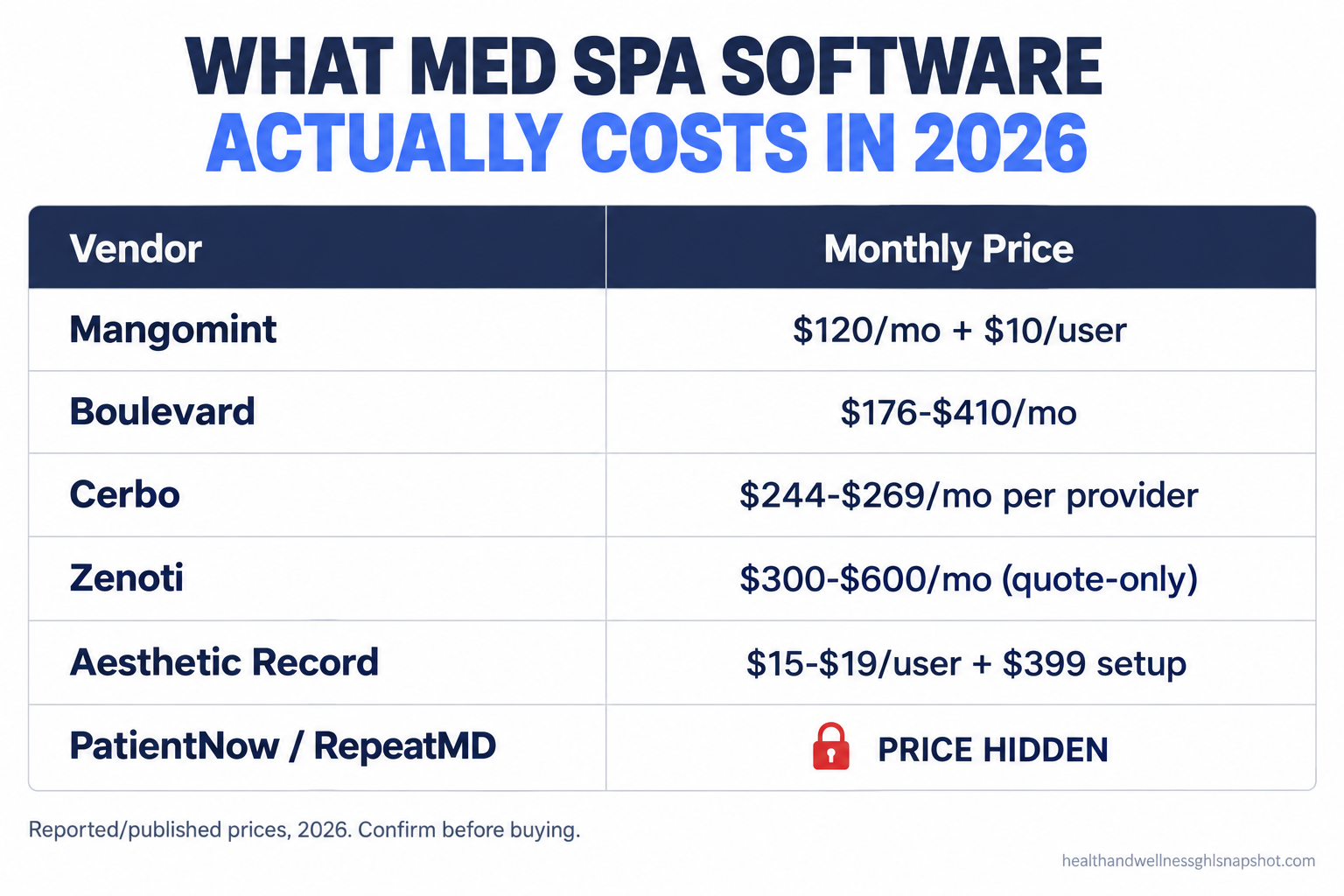
Table of contents
- Why the software line item deserves a hard look
- The six costs the sticker price hides
- The real 2026 prices, vendor by vendor
- The three vendors that won’t show a number
- What a solo, a three-location, and a larger clinic actually pay
- The compliance costs nobody quotes you
- Common objections, answered honestly
- Frequently asked questions
Why the software line item deserves a hard look
Software has quietly become one of the largest fixed costs a small wellness clinic carries, and most owners have never added it up. You signed up for a booking tool, then bolted on charting, a marketing add-on, a texting service, a payments processor. Each felt small. Together they can run more than your utilities.
That matters more now because the market is crowded and growing, which means more vendors chasing you with slick demos and vaguer pricing. The IV hydration therapy market is projected to grow from about $2.8 billion in 2025 to $3.0 billion in 2026, reaching $5.7 billion by 2033 at a 9.2% CAGR (Grand View Research). The medical spa industry has, by the American Med Spa Association’s reporting, eclipsed $17 billion in revenue across 11,000-plus med spas, with the average location generating about $1,398,833 in 2024, up from $1,307,587 in 2023 (AmSpa, 2024).
If you’re an RN or NP who opened a clinic to do clinical work, not to reconcile four subscriptions, getting this wrong costs real money and real hours. Nearly 70% of med spa owners are women running lean operations (AmSpa, 2024) that feel every recurring dollar.
The six costs the sticker price hides
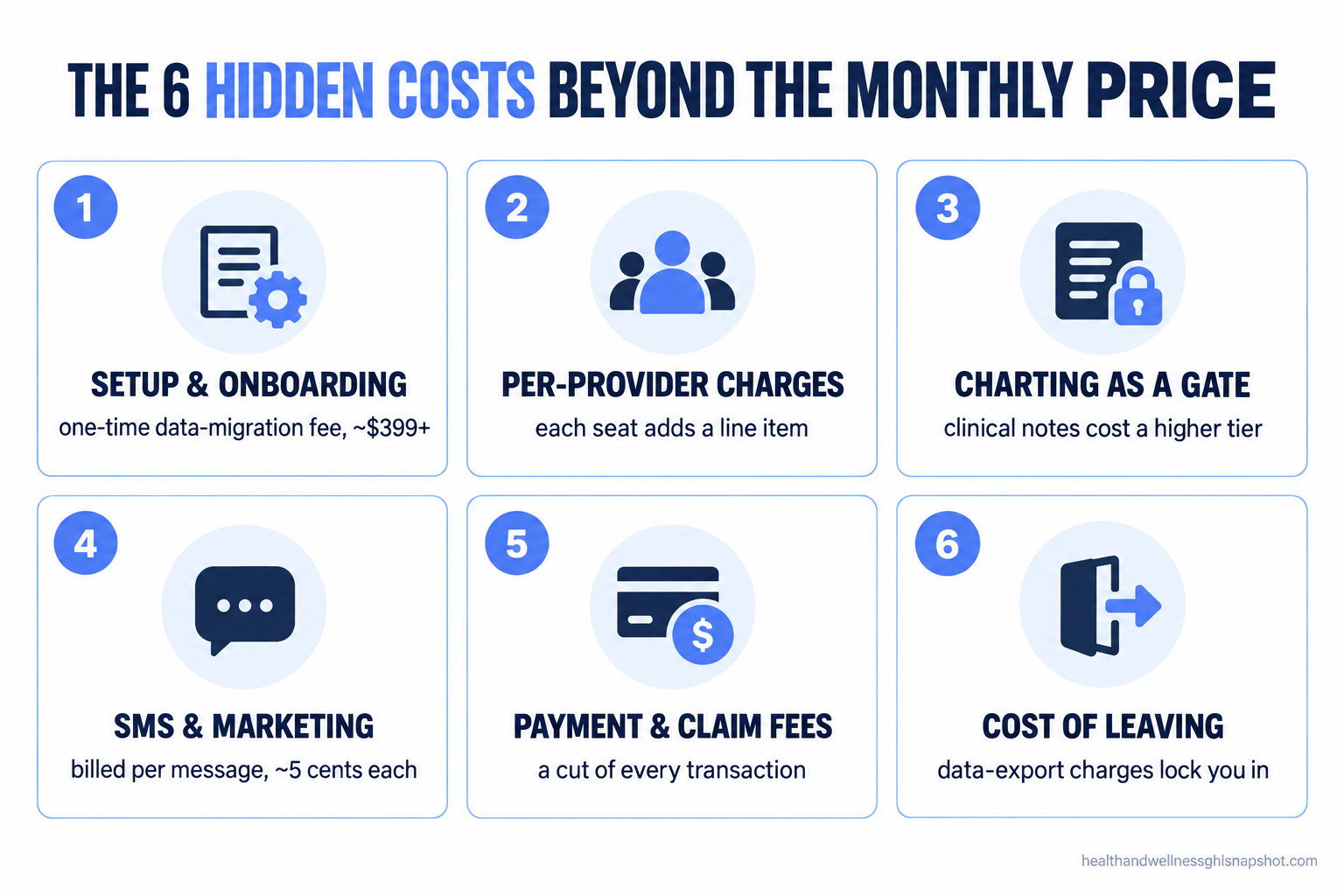
Before any vendor names, learn the six places the money actually goes.
- Setup and onboarding fees. A one-time charge to migrate and configure your data. Aesthetic Record reports about $399 onboarding (Capterra); larger EHRs quote four figures through sales.
- Per-provider and per-user charges. The base price often covers one seat. Jane adds a line per practitioner (Pabau); Mangomint adds $10/mo per user on top of the location fee (Mangomint); Cerbo bills prescribing providers, supporting providers, and staff separately (Cerbo).
- Clinical charting as a gate. Booking and medical charting aren’t the same product, and charting is often where the price jumps or a tool stops. This is the most common buying trap for clinics that inject anything.
- SMS, reminders, and marketing add-ons. Text reminders are often billed per message or bundled only at higher tiers. Practice Better charges roughly 5 cents per SMS reminder and meters telehealth AI minutes (Pabau).
- Payment-processing and claims fees. A cut of every transaction, or a per-claim charge. SimplePractice is adding claim fees from $0.39 per claim in October 2026 (SimplePractice).
- The cost of leaving. Data-export or offboarding charges. Some Aesthetic Record users report steep export fees when leaving. Treat any offboarding charge as part of the price of getting in.
The real 2026 prices, vendor by vendor
Below are the published or reported prices at the time of writing, with the source for each. Prices change often, so confirm the live number before you sign.
Reported base monthly cost per location (before add-ons), 2026. Sources: Mangomint, Capterra (Boulevard), Cerbo, Capterra (Zenoti).
Boulevard: strong booking and POS, charting sits in the pricier lane
Boulevard’s base tiers run about Essentials $176/mo, Premier $293/mo, and Prestige $410/mo per location, with roughly 10% off annual billing (Capterra). It’s polished booking and POS software, but HIPAA coverage and the med-spa clinical features are tied to its aesthetics offering (reported around $421/mo), not the base tiers, and two-way SMS is capped by tier. How it breaks: a clinic that buys the base tier to save money finds the clinical and compliance pieces sit a level up, so the “cheap” plan was never really an option.
Mangomint: now includes charting, but it is not a full clinical EHR
As of 2026, Mangomint is $120/mo per location plus $10/mo per user, with add-ons for marketing (from about $30/mo), phone, and payroll (Mangomint). It now includes Forms and Charting with SOAP notes and markets itself as a HIPAA-compliant med spa EMR (Mangomint). How it breaks: it has charting, but it is not a deep clinical EHR. There’s no e-prescribing and no lab integration, so a prescribing hormone or weight-loss clinic still needs a separate workflow. For a cash-pay IV bar it may be plenty; for a prescribing clinic it’s half the stack.
Zenoti: enterprise features, quote-only pricing
Zenoti is reported at roughly $300–$600/mo per location and lists “starts at $300/month,” but the real price comes only through a sales demo (Capterra; Pabau). It’s built for multi-location operators. How it breaks: the opaque per-location pricing means you can’t compare it honestly against a published-price competitor without the sales process first, and the number climbs with each location and module.
Jane App: honest per-provider pricing that adds up with a team
Jane’s tiers are CAD $54/mo (Balance), $79/mo (Practice), and $99/mo (Thrive) for a solo practitioner, with extra practitioners adding roughly CA$17.50–$40 each and insurance billing from about $20/mo (Pabau; Capterra). Prices are in Canadian dollars, which trips up US buyers. How it breaks: it looks cheapest until you’re a three-provider clinic, when every seat plus the billing add-on stacks into a real monthly number.
IntakeQ / PracticeQ: forms-first, priced per practitioner
IntakeQ starts around $49.90/mo for forms and $79.90/mo for practice management; PracticeQ runs $59.90/mo (Starter) and $84.90/mo (Pro), metered by appointment and form volume, with e-prescribing as an add-on (PracticeQ; Capterra). How it breaks: the volume caps mean a busy clinic can outgrow a tier mid-month and get nudged up.
Healthie: cheap to start, enterprise-priced to scale
Healthie’s published tiers are Core $19.99/mo, Essentials $49/mo, Plus $129.99/mo, and Group $149.99/mo, with extra Group providers adding about $50/mo each (Healthie). How it breaks: the entry price is genuinely low, but larger group and enterprise onboarding is quoted through sales, so what a growing functional-medicine practice actually pays isn’t the number on the pricing page.
Cerbo: purpose-built for prescribers, priced accordingly
Cerbo charges $269/mo per prescribing provider and $244/mo per non-prescribing provider, with supporting providers around $121/mo, staff seats about $60/mo, and a reported one-time setup fee (Cerbo; Software Finder). How it breaks: it’s a real EHR for functional and integrative medicine, so the per-provider model means a clinic with several prescribers pays a genuine EHR bill every month.
Practice Better and SimplePractice: the coaching-side options
Practice Better runs $35–$155/mo (roughly 20% cheaper annually) with SMS reminders around 5 cents each (Practice Better); SimplePractice is $49–$99/mo, with per-claim fees arriving October 2026 (SimplePractice). How they break: both lean toward solo coaching, so a clinic doing injectables or IVs will find the clinical and inventory pieces thin.
The three vendors that won’t show a number
When a vendor hides pricing, it’s usually because the number is high, variable, or negotiated per deal. That’s not a reason to walk away, but it is a reason to slow down.
- Aesthetic Record publishes low per-user tiers (about $15–$19/user/mo) but pushes larger practices to a custom Enterprise quote; its $399 onboarding fee and reported data-export charges are the parts that catch people (Capterra).
- PatientNow is quote-only. Reported figures land around $200/user/mo for small practices and $150/user/mo at scale, and its late-2025 “Essentials” tier has no public price (Pabau; Software Advice).
- RepeatMD publishes no price at all. Its site is entirely demo-gated, and the only figures around are third-party estimates (Software Finder). For a membership and e-commerce layer, that’s a lot to sign up for blind.
The pattern across all three: the demo comes first, the price last. Go in with the six questions above and refuse to move without a written total.
What a solo, a three-location, and a larger clinic actually pay
The same vendor costs very different amounts depending on your shape. Here’s the honest math for three common setups over three years, built from the published prices above, before payment processing.
Scenario 1: solo cash-pay IV bar, one provider
A single-location IV lounge that doesn’t prescribe can run lean. Mangomint at $120/mo plus one $10 user is $130/mo, about $1,560 a year; add a $30/mo marketing add-on and you’re near $1,920/year, roughly $5,760 over three years. The trap is buying an enterprise tool you don’t need: Zenoti’s reported $300/mo floor would cost more than double for features a solo cash-pay bar won’t touch.
Scenario 2: three-location hormone and weight-loss clinic, five providers
This is where per-provider pricing bites. On Cerbo, five prescribing providers at $269/mo is $1,345/mo in provider fees alone, about $16,140 a year before staff seats and setup; add those and year one clears $18,000-plus. Boulevard’s aesthetics tier at roughly $421/mo across three sites adds about $15,156 a year for booking and POS alone, separate from clinical charting. A prescribing multi-site clinic realistically runs $30,000–$50,000 over three years across a booking-plus-EHR stack.
Scenario 3: larger med spa group, quote-only territory
At multiple locations with memberships and e-commerce, you’re in Zenoti, PatientNow, and RepeatMD territory, where pricing is negotiated. At Zenoti’s reported $300–$600/mo per location, four locations is $14,400–$28,800 a year before modules, and the add-ons are where it grows. Three-year totals here reach six figures.
Illustrative three-year software spend by clinic size, built from the published 2026 prices above (before payment processing). Midpoints shown for ranges.
The point isn’t that software is a rip-off. It’s that the recurring model means your bill grows with your team and locations, forever. That’s why some owners pull the pieces that don’t need to live in the EHR (reminders, no-show recovery, review requests, membership billing recovery) onto a platform they own outright instead of renting per seat.
The compliance costs nobody quotes you
The cheapest software becomes the most expensive if it puts you on the wrong side of a regulator. Three areas deserve a budget line, even though no vendor invoices you for them.
HIPAA is not automatic, and not universal. If your clinic bills insurance or shares protected health information with a covered entity like a lab or referring physician, you almost certainly need a Business Associate Agreement with any software that touches patient data (HHS). A pure cash-pay IV bar may fall outside federal HIPAA but still owes state privacy and breach-notification duties. Don’t let a vendor’s “HIPAA-compliant” badge do your thinking; get the BAA in writing and confirm it covers texting.
FTC health-claim substantiation is the bigger exposure. The FTC has warned roughly 700 weight-loss and wellness marketers and sent letters to IV-therapy companies over immune and COVID claims (FTC). Any copy that says “boosts immunity,” “melts fat,” or “detoxes,” or implies your compounded GLP-1 equals a brand-name drug, needs competent and reliable evidence or softening. And the FDA declared the semaglutide and tirzepatide shortages resolved in late 2024 and early 2025, so “shortage” is no longer a valid compounding justification in 2026 (FDA). Your automated messages are marketing, and carry a billboard’s liability.
Health-related SMS draws heavier carrier filtering. Ten-digit long code (10DLC) brand registration matters more for a clinic than a retailer, because health keywords trip spam filters. Budget for registration and consent capture, and read our guide on HIPAA-aware SMS for wellness practices before turning on a single automated text, the consent gating our SMS automation feature handles.
Common objections, answered honestly
“I already pay for Boulevard (or Jane, or Cerbo). Why would I change anything?” You probably shouldn’t rip out your EHR or POS; those do clinical and payment jobs that need to stay put. The narrower question: are you also paying that tool, or a fourth subscription, to send reminders, recover no-shows, and ask for reviews? Those follow-up jobs get expensive per seat and are the easiest to move onto something you own. Keep the clinical system; reconsider the follow-up layer.
“Do I really need clinical charting, or is booking software enough?” If you inject, infuse, or prescribe, you need real charting and, for prescribers, e-prescribing. This is the trap that catches new clinics: they buy a beautiful booking tool, then find it can’t hold a note that stands up to a board inquiry. Decide whether you’re clinical first. If you are, charting is not the add-on to cut.
“GoHighLevel isn’t medical software. How does it fit?” It doesn’t replace your EHR. It’s the marketing, reminder, follow-up, review, and membership-nurture layer that sits alongside your clinical system. That’s the slice the Wellness Snapshot installs as a one-time build, not a monthly per-provider fee, and custom clinical integrations are a custom software conversation.
The bottom line
Back to that demo call where nobody would name a price. The hidden number is almost never in your favor. Now you have the real figures, the six hidden costs, and the math for your size, so you can walk into any demo, ask the six questions, and refuse to move without a written total. Separate the two decisions: the clinical system you charge and prescribe in, and the follow-up layer that reminds, recovers, and re-books. The first is worth paying monthly for. The second is worth owning once. To see how much of a marketing stack can live on a platform you buy a single time, book a quick demo and compare it against the subscriptions you carry now.
Frequently asked questions
What is the cheapest med spa software in 2026?
Mangomint's $120/mo per location (plus $10 per user) and Practice Better's $35/mo Starter are the lowest published entry points, and both now include some charting. But 'cheapest' depends on team size and whether you prescribe: a solo cash-pay IV bar can run under $2,000 a year, while a multi-provider clinic on an EHR like Cerbo pays far more per provider.
Why won't some med spa software companies show their prices?
Aesthetic Record's higher tiers, PatientNow, and RepeatMD gate pricing behind a demo, usually when the price is high, variable, or negotiated per deal. Insist on a written total for your exact providers and locations, including setup and export fees, before committing.
Does Mangomint have clinical charting?
Yes. As of 2026 Mangomint includes Forms and Charting with SOAP notes and markets itself as a HIPAA-compliant med spa EMR. But it's not a deep clinical EHR: no e-prescribing and no lab integration, so a prescribing hormone or weight-loss clinic still needs a separate workflow.
What hidden fees should I watch for in clinic software?
Six: one-time setup and onboarding fees, per-provider charges, charting locked behind a higher tier, per-message SMS and marketing add-ons, payment and per-claim fees, and data-export charges if you leave. The sticker price rarely includes these, so ask for a full first-year total in writing.
Is GoHighLevel a replacement for my EHR?
No. GoHighLevel and the Wellness Snapshot built on it are the marketing, reminder, follow-up, review, and membership-nurture layer that sits alongside your clinical EHR, not in place of it. You keep charging and prescribing in your medical system and move the follow-up jobs onto a platform you own once.
Do I need HIPAA-compliant software for a cash-pay IV clinic?
Possibly not federally, but don't assume. If you bill insurance or share patient data with a lab or referring physician, you're likely a HIPAA-covered entity and need a signed Business Associate Agreement. A pure cash-pay clinic may fall outside federal HIPAA but still owes state privacy and breach-notification duties.
This article is for general informational purposes and is not legal, medical, or compliance advice. Prices are as published or reported at the time of writing and change frequently; confirm the current figure on each vendor’s own page before purchasing. Each practice is responsible for its own HIPAA, TCPA, FTC, and state-licensing obligations.