Every wellness practitioner has felt the treadmill of the feed: you spend an evening filming a Reel about gut health, it does fine for a day, and by Thursday it’s buried and forgotten. You are renting attention by the hour. Pinterest works the opposite way — and almost no wellness practice in the U.S. is using it on purpose.
Pinterest is not a social feed; it is a visual search engine where people plan their health — meal prep, gut resets, hormone-balancing routines, supplement checklists — and a single well-made Pin keeps getting discovered and clicked for months, long after an Instagram post has gone cold. For a wellness coach or clinic, that makes Pinterest the closest thing to an evergreen, compounding source of booked discovery calls you can build. This is the sourced 2026 data on why that’s true, and a practical 7-step system to turn it into a real lead channel — including an honest look at why most solo practitioners can’t sustain it alone. Every statistic below is cited.
What you’ll find in this guide
- Why Pinterest is different from every other platform
- The 2026 numbers wellness practices should know
- How Pinterest actually books wellness clients
- The 7-step Pinterest content system
- Pinterest vs. Instagram: they do different jobs
- The honest catch — and the done-for-you fix
- FAQ
Why Pinterest is different from every other platform
Instagram, TikTok, and Facebook are feeds. Content is served in reverse-chronological, algorithm-ranked order, it peaks within hours, and then it’s gone. You have to keep feeding the machine or your reach falls off a cliff. That’s why “post every day or disappear” feels like a second job — because on a feed, it is.
Pinterest is a search and discovery engine. People come to it the way they come to Google: they type “hormone balancing breakfast,” “gut reset meal plan,” or “postpartum wellness routine,” and Pinterest returns visual results ranked by relevance — including Pins you published weeks or months ago. Pinterest’s own product direction underlines this: the company reported that AI-powered visual search queries grew 44% year over year in Q3 2025 as people increasingly search rather than scroll (Pinterest, Q3 2025).
The consequence for a wellness practice is enormous. On a feed, the value of a post decays to near zero in a day or two. On Pinterest, a Pin is an evergreen asset that keeps surfacing every time someone searches its topic.
Median working lifespan of one post, in days. Sources: Marketing Dive / Piqora (Pinterest ~16 weeks); widely-cited feed-platform benchmarks (Simply Measured / Piqora). Illustrative — exact lifespans vary by account and topic.
The 2026 numbers wellness practices should know
Pinterest is often dismissed as “the wedding-and-recipes app.” That framing is a decade out of date — and for wellness, the recipes part is exactly the point.
A few of these deserve unpacking for a wellness audience:
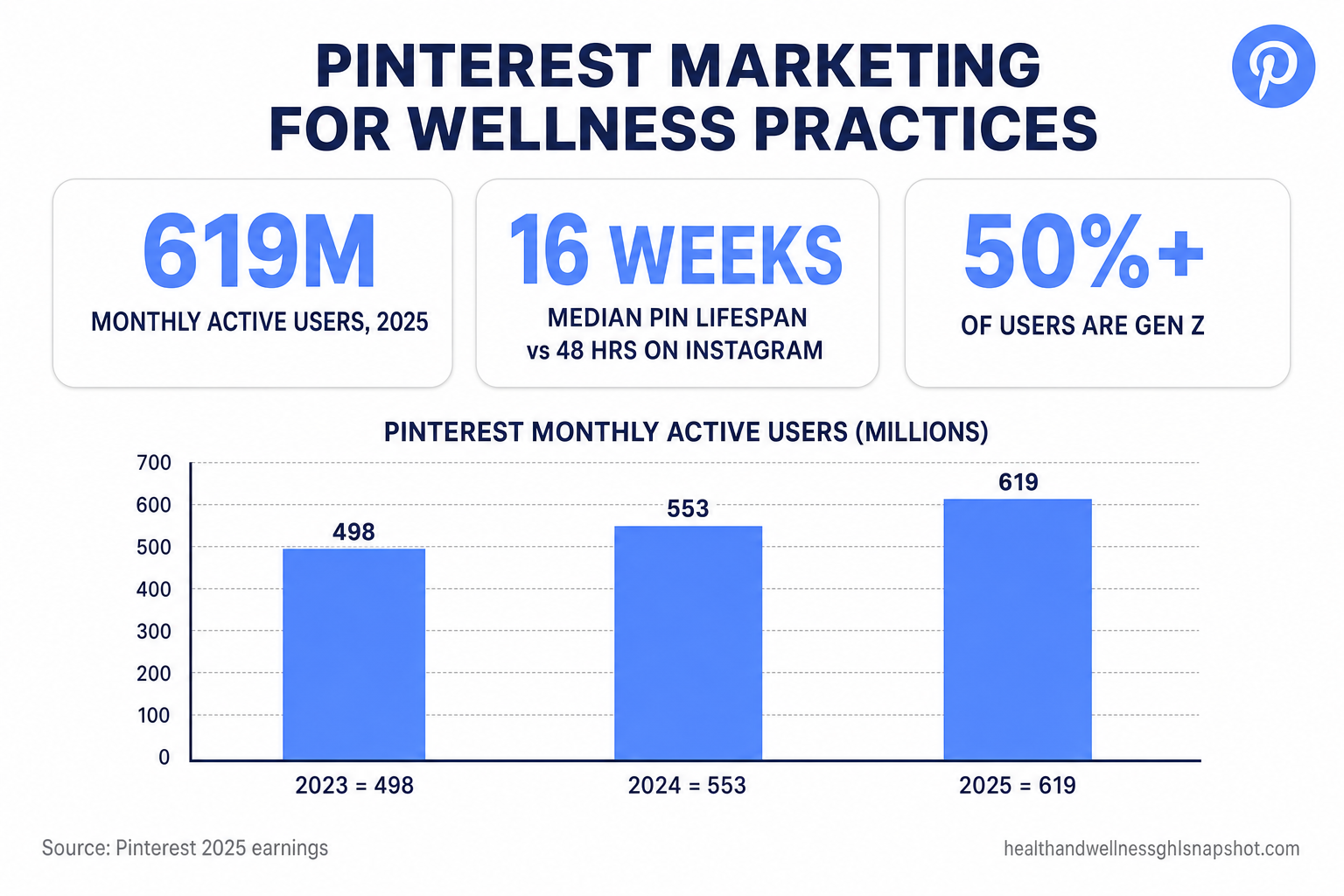
- 619 million people, and still climbing — and most are in the U.S. orbit. Pinterest reached a record 619 million monthly active users in Q4 2025, its tenth consecutive quarter of record users, on $4.2 billion in full-year revenue up 16% (Pinterest FY2025). Of those, roughly 356 million are in the U.S. and Canada (Pinterest Q4 2025 slides). This is not a shrinking niche.
- The demographic is your buyer. Pinterest skews heavily toward women — about 70% of users (Statista) — planning purchases and life changes, and Gen Z is now more than half the user base and its fastest-growing group (Pinterest, Q3 2025). That’s a generation, and a gender skew, that treats wellness as a category of spending, not an afterthought.
- Health & wellness is core inventory. Meal prep, self-care, fitness, supplements, and mental-wellness content sit among the most-saved categories on the platform, and Pinterest’s own annual trend forecasting leans heavily on wellness themes (Pinterest Predicts).
Pinterest global monthly active users, Q4 of each year (millions). Source: Pinterest Q4 & FY2025 results (619M in Q4 2025, up 12% from 553M).
How Pinterest actually books wellness clients
Pinterest doesn’t book clients the way an ad does — it books them the way a great blog post does, only visually and at search-scale. The mechanic is a chain:
- A prospect searches a wellness question (“bloating after every meal,” “perimenopause energy crash”).
- Your Pin — a clean, titled graphic or short video answering exactly that — shows up in results and gets saved to their board. A save is a bookmark and a distribution signal that shows the Pin to more people.
- The Pin links to a page you control: a booking calendar, a lead-magnet download, a relevant blog post, or a service page.
- Because the Pin is evergreen, steps 1–3 repeat for every future searcher, not just the audience who saw it the day you posted.
That last point is why Pinterest compounds. Every Pin you publish is another line permanently baited in the water. Contrast that with the feed, where you’re re-baiting the same hook every single day. And the mindset is right for you: by Pinterest’s own audience research, 89% of weekly users say they use the platform for inspiration on their path to purchase (Pinterest Business) — which, for a wellness practice, is the same moment someone decides to finally hire help. The original Pinterest referral study found that half of a Pin’s site visits arrive more than 3.5 months after it was first pinned (Piqora, via VentureBeat).
The same effort, two very different returns
Instagram Reel: 6 hours to film + edit + caption a week's content. Peaks in 24–48 hours, then reach collapses. Next week you start from zero.
Pinterest: repurpose that same content into 8–10 Pins. Each keeps surfacing in search for months, quietly sending booking-page clicks while you sleep.
The honest caveat: Pinterest is slower to start than a paid ad. It behaves like SEO — you’re building a library, and libraries take a few months to gain momentum before they pay you back for years. It is a compounding channel, not an instant one. If you need booked calls this week, run speed-to-lead and Instagram plays alongside it; Pinterest is the asset that makes next quarter easier.
The 7-step Pinterest content system for wellness practices
Here is the repeatable system. It’s deliberately built so that most of the work is repurposing content you already make, not creating brand-new content from scratch.
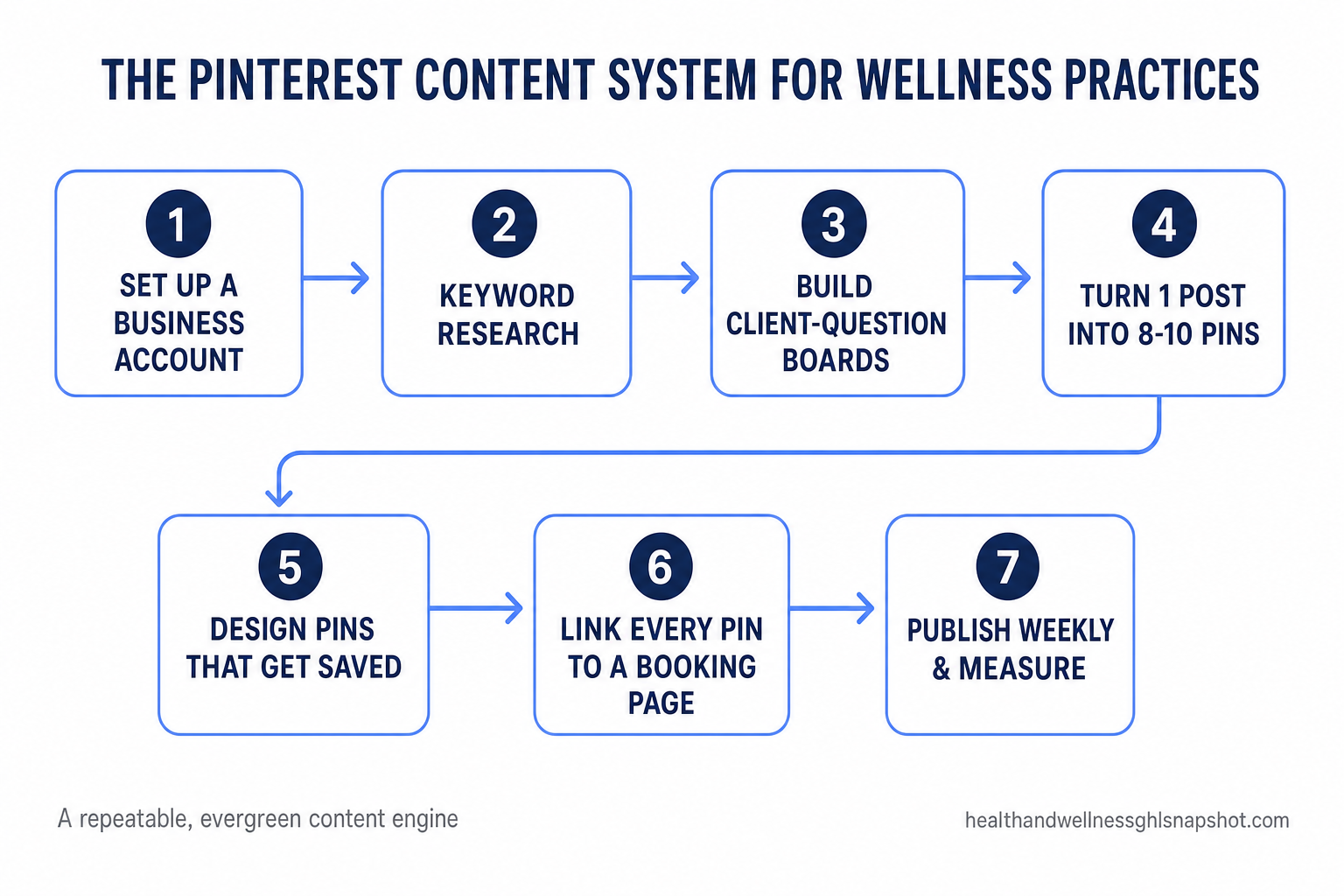
Step 1 — Set up a Pinterest Business account and claim your website
A free Business account unlocks analytics, ads, and — critically — the ability to claim your website so your logo and a follow button attach to every Pin that links to your domain. Claiming your site is a five-minute task that permanently improves attribution and trust. If you already have a personal account with saved boards, convert it or start clean.
Step 2 — Do keyword research the way clients actually search
Pinterest is a search engine, so treat it like one. Type a seed term (“gut health”) into the Pinterest search bar and read the auto-suggested tiles — those are real, popular queries. Build a list of 20–30 client-language phrases: “anti-inflammatory dinner,” “cortisol belly,” “PCOS meal plan,” “morning routine for energy.” These become your Pin titles, descriptions, and board names. This is the single highest-leverage step; skip it and you’re publishing into the void.
Step 3 — Build boards around client questions, not your services
Nobody searches “functional medicine intake process.” They search their problem. Create 8–15 boards named for the problems and goals your ideal client has — “Gut Health & Digestion,” “Balanced Hormones,” “Meal Prep for Busy Weeks,” “Better Sleep Routines.” Your practice’s expertise gets distributed across these problem-boards, meeting people at the exact moment of intent. (This is the same problem-first logic behind local SEO for wellness practices.)
Step 4 — Turn one piece of content into 8–10 Pins
This is the leverage move. One blog post, one Reel, or one client-question answer becomes:
- 2–3 static graphic Pins (different titles/designs testing different keywords)
- 1–2 “idea Pins” / video Pins (short, native, higher reach)
- 1 infographic or checklist Pin (the format that gets saved most)
- Fresh Pins pointing to the same URL over subsequent weeks
Pinterest rewards fresh Pins (new images), not re-posting the identical graphic — so vary the design and headline while pointing to the same destination. Ten Pins from one asset is a normal, healthy ratio.
Step 5 — Design Pins that earn the save
A Pin lives or dies on two things: a legible text overlay stating the value (“5-Day Gut Reset — No Restriction”) and a clean, on-brand vertical image (2:3 ratio, 1000×1500px). Use your practice colors and one readable sans-serif. The goal isn’t art; it’s a readable promise someone bookmarks for later. Checklists, “X vs Y,” and numbered-step graphics consistently outperform pretty lifestyle photos because they’re useful.
Step 6 — Link every Pin to a page that captures the lead
A Pin with no destination is a billboard in a desert. Every Pin must link to a page built to convert: a discovery-call booking calendar, a lead magnet download that captures an email, or a fast, mobile-first landing page. This is where a slow or missing website quietly wastes all the upstream work — if the page takes four seconds to load, the click evaporates. A purpose-built wellness site closes that gap.
Step 7 — Publish consistently and measure the right things
Pinterest rewards steady output — a handful of fresh Pins per week beats 50 in one burst and then silence. Track three numbers in Pinterest analytics: saves (did it resonate?), outbound clicks (did it send traffic?), and — the only one that pays your bills — booked consults attributed to Pinterest via your CRM. Vanity impressions are noise; outbound clicks and booked calls are signal.
Pinterest vs. Instagram: they do different jobs
This is not “quit Instagram.” Reels are still the best tool on the internet for reach and personality — for getting discovered by someone who didn’t know they needed you. We wrote a whole Reels-first playbook for exactly that. The point is that the two platforms do different jobs, and most wellness practices are running only one of them.
| Job | Instagram / TikTok (feed) | Pinterest (search) |
|---|---|---|
| Core mechanic | Reach & personality | Intent & discovery |
| Content lifespan | Hours to days | Weeks to months |
| Best for | Being found & building trust | Being searched for & booking |
| Effort model | Constant new content | Repurpose + compound |
| Client mindset | Scrolling, entertained | Planning, deciding |
Run together, they form a loop: film the Reel once for reach, then repurpose it into ten evergreen Pins that keep working long after the Reel is buried. Same footage, twice the mileage.
The honest catch — and the done-for-you fix
Everything above is doable. It’s also, realistically, 4–6 hours a week of keyword research, design, writing, scheduling, and analytics — every week, for months, before it compounds. The practitioners who win on Pinterest either love the work or have someone doing it for them. Most don’t have the first and haven’t hired the second, which is why the channel sits empty for nearly every wellness practice in the country. That’s the opportunity: it’s wide open precisely because it’s tedious to sustain solo.
That’s the exact gap our done-for-you social media system is built to close. We batch-produce your content once and syndicate it across nine channels — including Pinterest, with keyword-researched boards, repurposed Pins, and booking-page links — plus AI agents that answer the comments and DMs that content generates, so attention turns into booked consults instead of unread notifications. You keep seeing clients; the content engine runs without you.
Related reading
- Social Media for Wellness Practices: A Reels-First System That Books Clients
- How Wellness Practices Get Found in AI Search (AEO Playbook)
- Local SEO for Wellness Practitioners: The 2026 Google Business Profile Playbook
- Lead Magnets for Wellness Coaches That Actually Convert
- Speed to Lead: Why a 5-Minute Reply Wins More Wellness Clients
Frequently asked questions
Is Pinterest still relevant for a wellness business in 2026?
Yes — more than ever. Pinterest reached a record 619 million monthly active users in Q4 2025 (up 12% year over year), and health, wellness, meal prep, and self-care are among its most-saved categories. Because it's a search engine rather than a feed, it's especially well-suited to wellness, where people actively plan routines, meal plans, and lifestyle changes before they ever hire a provider.
How is Pinterest different from Instagram or TikTok?
Instagram and TikTok are feeds: content peaks within hours and then disappears, so you must post constantly to stay visible. Pinterest is a visual search engine: a Pin keeps showing up in search results for months. A widely-cited analysis put the median Pin's working life at about 16 weeks versus roughly 48 hours for an Instagram post — so Pinterest content compounds instead of decaying.
How long until Pinterest starts driving booked consults?
Treat it like SEO, not ads. Most wellness accounts see momentum build over roughly 2–4 months of consistent, keyword-driven publishing, after which the same Pins keep driving traffic and bookings for a long time. It's a compounding channel, not an instant one — pair it with faster plays like Instagram Reels and speed-to-lead follow-up if you need calls this week.
How many Pins should a wellness practice publish per week?
Consistency beats volume. A handful of fresh Pins per week — new images and titles, even pointing to the same pages — outperforms publishing 50 in one burst and then going dark. The single biggest reason wellness Pinterest accounts fail is that they stop after a few weeks, and the platform's momentum resets.
Can you run Pinterest for my practice for me?
Yes. Our done-for-you social media system includes Pinterest alongside eight other channels: we research keywords, build problem-based boards, repurpose your existing content into evergreen Pins, link each one to your booking page, and run AI agents that handle the comments and DMs your content generates. You keep seeing clients while the engine runs.
Anjali Mehta is the Wellness Growth Editor at the Health & Wellness GHL Snapshot. She covers the business of wellness — pricing, group-program economics, referral systems, and the marketing channels that decide whether a great practitioner stays small or scales. She has a low tolerance for hype and a strong preference for honest math over motivational fluff. Anjali writes about GoHighLevel automation and wellness-practice marketing; she is not a licensed medical or clinical provider, and nothing here is medical advice.