
A prospective client in South Tampa finds your functional-medicine practice on her phone at 9:40 p.m. She’s ready — she’s been meaning to deal with her fatigue for months. She taps your website, waits three seconds for it to load, squints at a menu built for a laptop, hunts for a way to book, finds a contact form that asks for nine things and promises a reply “within 1–2 business days,” and closes the tab. She books with the clinic down Bayshore whose site opened instantly and put a calendar in front of her. You never knew she was there. Your traffic report just calls her a “bounce.”
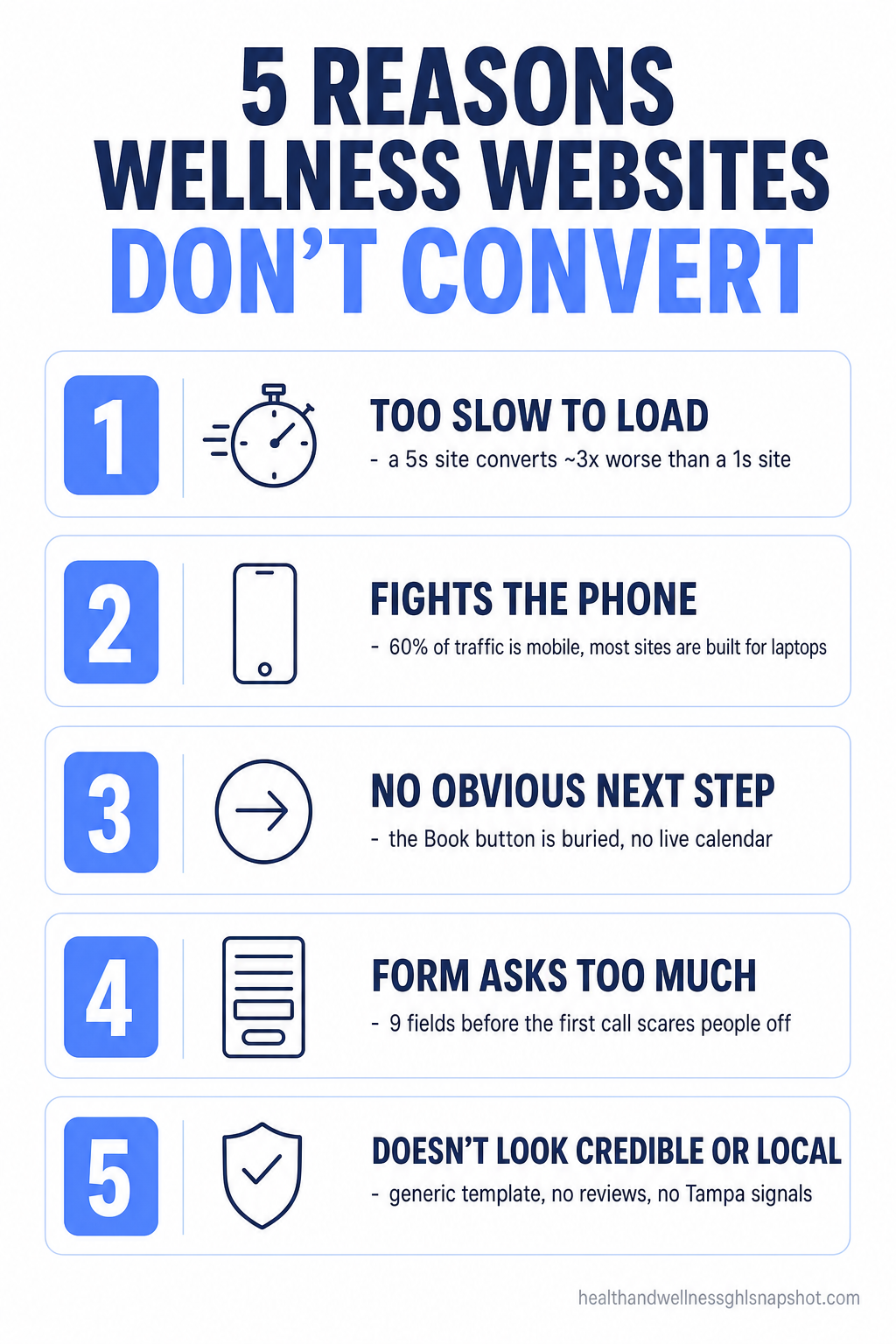
Most Tampa wellness websites don’t convert because they were built to look nice, not to book consults — they load too slowly, break on a phone, bury the next step, ask for too much too soon, and give a nervous first-time client no reason to trust them. Traffic isn’t usually the problem; the average healthcare website converts just 3.1% of its visitors (First Page Sage, 2024), which means 97 of every 100 people you worked to attract leave without doing anything. This is a plain-language look at the five reasons that happens in a wellness practice, each one sourced — and the conversion-first fixes that turn the same traffic into booked consults.
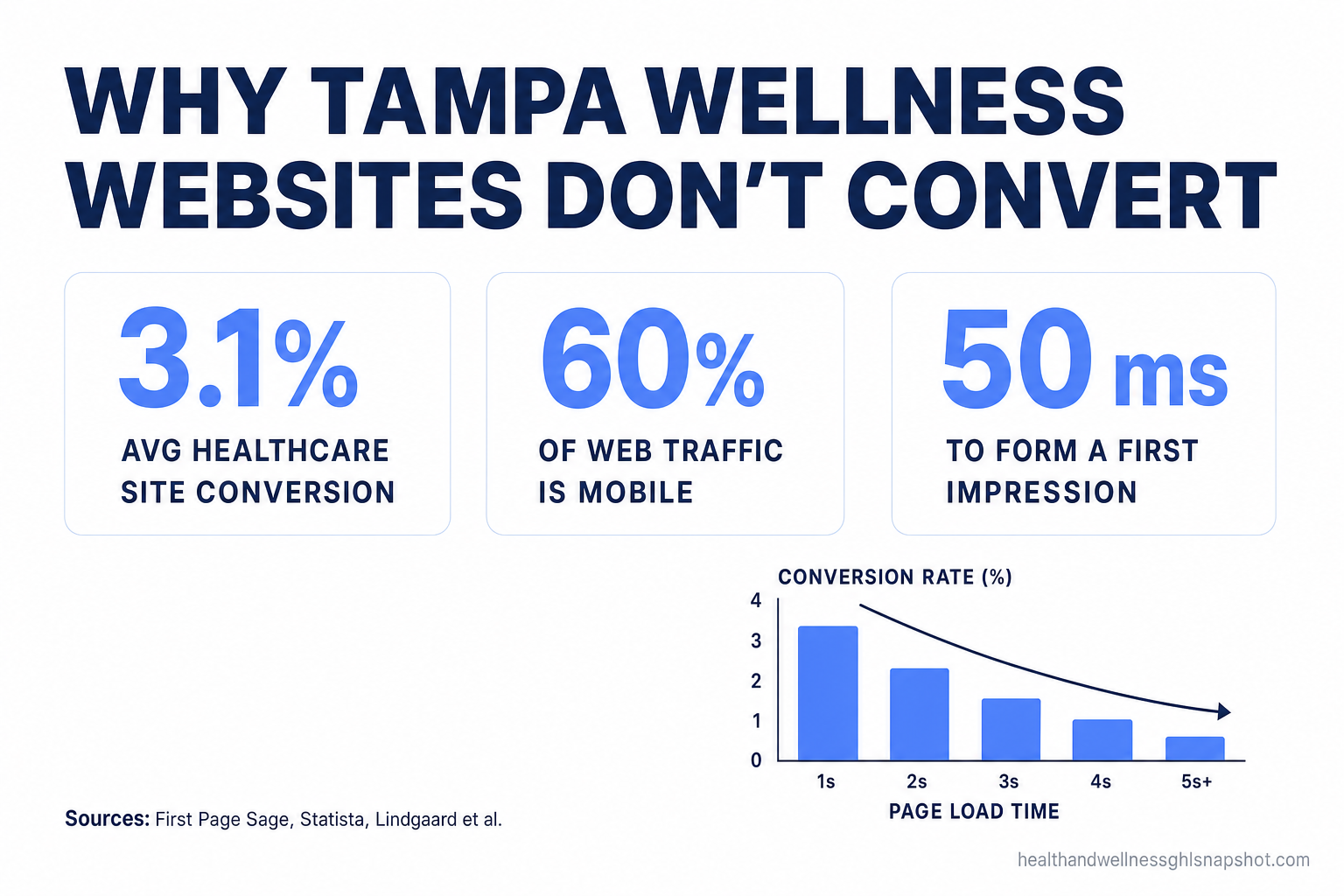
Table of contents
- Traffic isn’t your problem — conversion is
- Reason 1 — It loads too slowly
- Reason 2 — It fights the phone
- Reason 3 — There’s no obvious next step
- Reason 4 — The form asks for too much, too soon
- Reason 5 — It doesn’t look credible or local
- The fix: a conversion-first Tampa wellness site
- Frequently asked questions
Traffic isn’t your problem — conversion is
Before you spend another dollar getting people to your website, look at what happens to the people already arriving — because for most Tampa wellness practices, that’s where the money is quietly leaking. The average healthcare website converts about 3.1% of visitors into an inquiry, form fill, or booking (First Page Sage, 2024). Top performers reach 8–10%. The gap between those two numbers is not more traffic — it’s a site built to convert.
The math is unforgiving in a good way. If 500 people visit your site a month and you convert 3%, that’s 15 inquiries. Lift conversion to 6% — entirely achievable with the fixes below — and the same 500 visitors produce 30. You doubled your booked consults without buying a single extra click. That is almost always cheaper and faster than doubling ad spend or grinding out twice the SEO.
Tampa makes the stakes concrete. Florida is home to roughly 3.5 million small businesses — 99.8% of all businesses in the state (SBA Office of Advocacy, 2025) — and the wellness category is one of the most crowded corners of it, riding a US wellness economy that reached about $2.1 trillion in 2024 (Global Wellness Institute, 2024). A prospective client comparing three Tampa nutrition coaches or hormone clinics rarely picks the best practitioner — they pick the one whose website made booking feel easy. Let’s walk through the five reasons yours might not.
Reason 1 — It loads too slowly
A slow website doesn’t annoy visitors so much as quietly delete them before they ever see your offer. Portent’s analysis of more than 100 million pageviews found that a site loading in one second converts about 3× better than one that takes five seconds, and about 5× better than one that takes ten — with the first five seconds carrying the highest impact on conversion (Portent). Google’s mobile research puts it another way: as page load time climbs from one second to five, the probability that a visitor bounces rises by 90% (Think with Google).
Increase in the probability that a mobile visitor bounces as page load time grows (baseline = 1-second load). Source: Think with Google, mobile page speed benchmarks.
Speed isn’t only a conversion lever; it compounds. Even a 0.1-second improvement in mobile load time lifted retail conversions by 8.4% in a 37-brand study by Deloitte for Google (web.dev, “Milliseconds Make Millions”). The culprit on most wellness sites is the platform: a page-builder theme with a stack of plugins, hero videos, and tracking scripts that all have to load before a nervous first-time client can read a word. We cover the mechanics in depth in why slow wellness websites lose Seattle clients and in Astro vs WordPress for wellness sites — but the short version is that a static, edge-served site opens instantly, and most builder sites don’t.
Reason 2 — It fights the phone
Your website is being judged on a phone, held one-handed, mid-scroll, by someone with very little patience — and most wellness sites were designed on a wide laptop screen. About 60% of all web traffic is now mobile (Statista, 2024), and for a local service that people search for in the moment they need it, the mobile share is usually higher still. If your booking button sits below a giant hero image, your phone number isn’t tap-to-call, or your text is too small to read without pinching, you are asking a motivated person to work for the privilege of paying you.
First impressions form faster than most practitioners realize. Research published in Behaviour & Information Technology found that people form an opinion of a website’s visual appeal in about 50 milliseconds — one-twentieth of a second — and that snap judgment colors everything they do next (Lindgaard et al., 2006). On a phone, that first fiftieth of a second is your whole shot at looking like a practice worth trusting with someone’s health.
Reason 3 — There’s no obvious next step
A wellness website converts when it makes one action unmistakable — book a consult — and most sites bury it behind “Learn More,” “Contact Us,” and a wall of about-me copy. A prospective client shouldn’t have to decide what to do next; the page should decide for her. When the primary action is a single, repeated, high-contrast “Book a free consult” button that opens a real calendar, the visitor who’s ready can act on the impulse that brought her there.
Timing is the other half. Nearly half of health appointments are now booked after office hours (Zocdoc) — evenings, weekends, the gap between putting the kids to bed and going to sleep. A contact form that promises a human reply “within 1–2 business days” is closed for business at exactly the moment most people decide to reach out. And even when someone does submit a form, speed of response decides whether it turns into a client: businesses that contact a web lead within an hour are about 7× more likely to have a qualifying conversation than those that wait longer (Harvard Business Review).
The fix is to let the site itself take the next step 24/7 — a live booking calendar, and ideally an AI chat widget that answers questions and books the consult while your front desk is dark. It’s the same principle behind our speed-to-lead playbook: the practice that responds first usually wins, and after hours, “first” means automated.
Reason 4 — The form asks for too much, too soon
Every field you add to a form is another reason to abandon it, and wellness intake forms are usually the worst offenders on the whole site. A first-time visitor who just wants to book a discovery call does not need to hand over her full health history, insurance details, and date of birth before she’s even spoken to you. HubSpot’s analysis of tens of thousands of forms found that conversion rate falls as fields pile up — and that cutting a form from four fields to three lifted conversions by roughly 50%, while breaking a long form into a multi-step flow converted about 86% better than the same questions on one intimidating page (HubSpot).
Relative lift in form conversion from reducing friction. Source: HubSpot, form conversion optimization.
The lesson from e-commerce is the same: length and complexity are top reasons people bail, with about 18% of shoppers abandoning a checkout because it’s too long or complicated (Baymard Institute, 2024). For a wellness booking, ask for the minimum that lets you get on a call — name, email or phone, and what they want help with. Everything else can come in the intake sequence after they’re booked, which is precisely where a done-for-you system like ours collects it, in stages, without scaring anyone off.
Reason 5 — It doesn’t look credible or local
A wellness client is handing you her body and her trust, so a site that looks generic, dated, or unmistakably not-from-here loses her before the offer even registers. Design is a credibility signal: in Stanford’s web-credibility research, 46.1% of people said they assessed a site’s trustworthiness based in part on its overall visual design — layout, typography, and color (Stanford Web Credibility Project, 2002). It’s not about looking flashy; it’s about looking like a real, current, careful practice.
Local proof matters just as much, especially in a market as competitive as Tampa. Reviews are now the default trust check: about 75% of consumers “always” or “regularly” read online reviews for local businesses, and roughly 81% read them on Google (BrightLocal, 2024). A wellness site that surfaces real Google reviews, names the neighborhoods it serves, and reads like it belongs in Tampa converts better than a polished template that could be anywhere. Pair that with the fundamentals in local SEO for wellness practitioners and a system to harvest more Google reviews, and the site starts doing your credibility work for you.
A pretty site vs. a site built to book
A slow, laptop-designed homepage opens after four seconds. The hero is a stock photo and a mission statement. 'Book' is a small link in the top-right menu. The contact form asks for nine fields and promises a reply in 1–2 business days. On a phone, the client pinches, scrolls, gives up, and books elsewhere.
The page opens in under a second on her phone. A single 'Book a free consult' button is on screen immediately, opening a live calendar. Real Google reviews and Tampa neighborhoods are right there. The form asks three things. She books at 9:40 p.m. and gets an instant confirmation text — no human on shift required.
The fix: a conversion-first Tampa wellness site
None of these five problems needs a bigger marketing budget — they need a website built, from the first line of code, to turn a visit into a booked consult. That means a genuinely fast, static-first site; a mobile layout where booking is the obvious action; a live calendar and after-hours chat instead of a slow form; a short, staged intake that doesn’t scare people off; and real local proof that earns a nervous first-timer’s trust. Get those right and the same traffic you already have starts producing noticeably more consults.
If you’d rather not start from scratch, the same conversion-first site ships inside the Wellness Snapshot as the prebuilt website feature, already wired to the booking, reminder, and review workflows that keep the calendar full. Either way, the goal is the same: stop paying to send people to a website that lets them leave.
Frequently asked questions
Tampa wellness website conversion — FAQ
What is a good conversion rate for a wellness website?
The average healthcare website converts about 3.1% of visitors into an inquiry or booking, with top performers reaching 8–10% (First Page Sage, 2024). For a wellness practice, a realistic near-term target is to move from the 2–3% range into the 5–7% range by fixing speed, mobile usability, the booking path, and form length — which roughly doubles booked consults on the same traffic.
Why does my Tampa wellness site get traffic but few bookings?
Almost always one of five things: it loads too slowly (a 1-second site converts ~3x better than a 5-second one, per Portent), it's hard to use on a phone (about 60% of traffic is mobile), the booking step isn't obvious, the form asks for too much before the first call, or the design doesn't look credible and local. Traffic gets people to the door; these five decide whether they walk in.
How much does page speed really affect conversions?
A lot. Portent found a 1-second load converts roughly 3x better than a 5-second load, Google's data shows mobile bounce probability rising 90% as load time goes from 1s to 5s, and Deloitte's study for Google found even a 0.1-second improvement lifted retail conversions by 8.4%. Speed is one of the highest-leverage, most measurable fixes available.
Should my wellness website use a booking calendar or a contact form?
A live booking calendar, with the form as a fallback. Nearly half of health appointments are booked after hours, when no one is answering a contact form, and businesses that respond to a web lead within an hour are about 7x more likely to qualify it (HBR). A calendar — ideally paired with an AI chat widget — lets a ready client book the moment she decides, instead of waiting on a callback.
How long should a wellness intake form be?
As short as possible to get the first call booked — typically name, email or phone, and what they want help with. HubSpot found cutting a form from four fields to three lifted conversions ~50%, and multi-step forms convert ~86% better than long single-step ones. Collect the full health history in a staged intake sequence after the person is booked, not before.
Can you build a conversion-first website for my Tampa practice?
Yes. Our Get a Website service builds an Astro-fast site with a guaranteed 90+ Google PageSpeed score, mobile-first layout, real Tampa location pages, a live booking calendar, and clean SEO, from $127/month plus a one-time build fee that isn't charged until the site is live and you're happy with it. The same conversion-first site also ships inside the Wellness Snapshot.
Written by Anjali Mehta, Wellness Growth Editor. Anjali covers the business of wellness — pricing, offers, referral systems, and the marketing decisions that decide whether a great practitioner stays small or scales. She has a low tolerance for hype and a preference for honest math. Anjali writes about practice growth and marketing technology; she is not a licensed healthcare provider, and nothing here is medical advice.
Keep reading: Why Slow Websites Lose Seattle Wellness Clients · Astro vs WordPress for Wellness Websites · How to Add an AI Chat Widget to a Wellness Website · Speed to Lead: Why the First 5 Minutes Decide the Client