
It is a Friday afternoon and a new client walks into your IV lounge. She is run down before a big weekend, books a Myers cocktail, and forty-five minutes later she feels like a different person. She tips your nurse, says it is the best she has felt in weeks, and means it. Then she walks out, and you never see her again.
Not because she did not like it. She loved it. She never came back because nothing ever asked her to. That is the quiet truth behind the one-and-done problem in IV therapy: your clients are not leaving over a bad experience, they are leaving because your clinic has no system that reaches out after the drip and gives them a reason to book the next one. This post is the fix. It is the full repeat-visit system, six stages from that first Friday drip to a monthly membership, with the actual text copy you can steal, the timing that works, and the way each stage breaks so you can avoid it.
Table of contents
- What a one-and-done client actually costs you
- The six-stage repeat-visit system
- Stage 1: Capture consent at the chair
- Stage 2: The same-day aftercare text
- Stage 3: The 5 to 7 day feel-check and rebook
- Stage 4: The monthly cadence reminder
- Stage 5: The membership offer
- Stage 6: The win-back
- Run it for your size: solo, three-location, mobile
- The compliance lines to respect
- Objections owners raise
- Frequently asked questions
What a one-and-done client actually costs you
The cost of a one-and-done client is not one lost sale, it is every visit she would have made over the next two years, plus the members she never referred. Say your average drip is $150. A client who comes once is worth $150. A client who comes back monthly for a year is worth $1,800, and if she converts to a membership she is worth that every year with almost no marketing cost. Same client, same first visit. The only difference is whether anything reached out after she left.
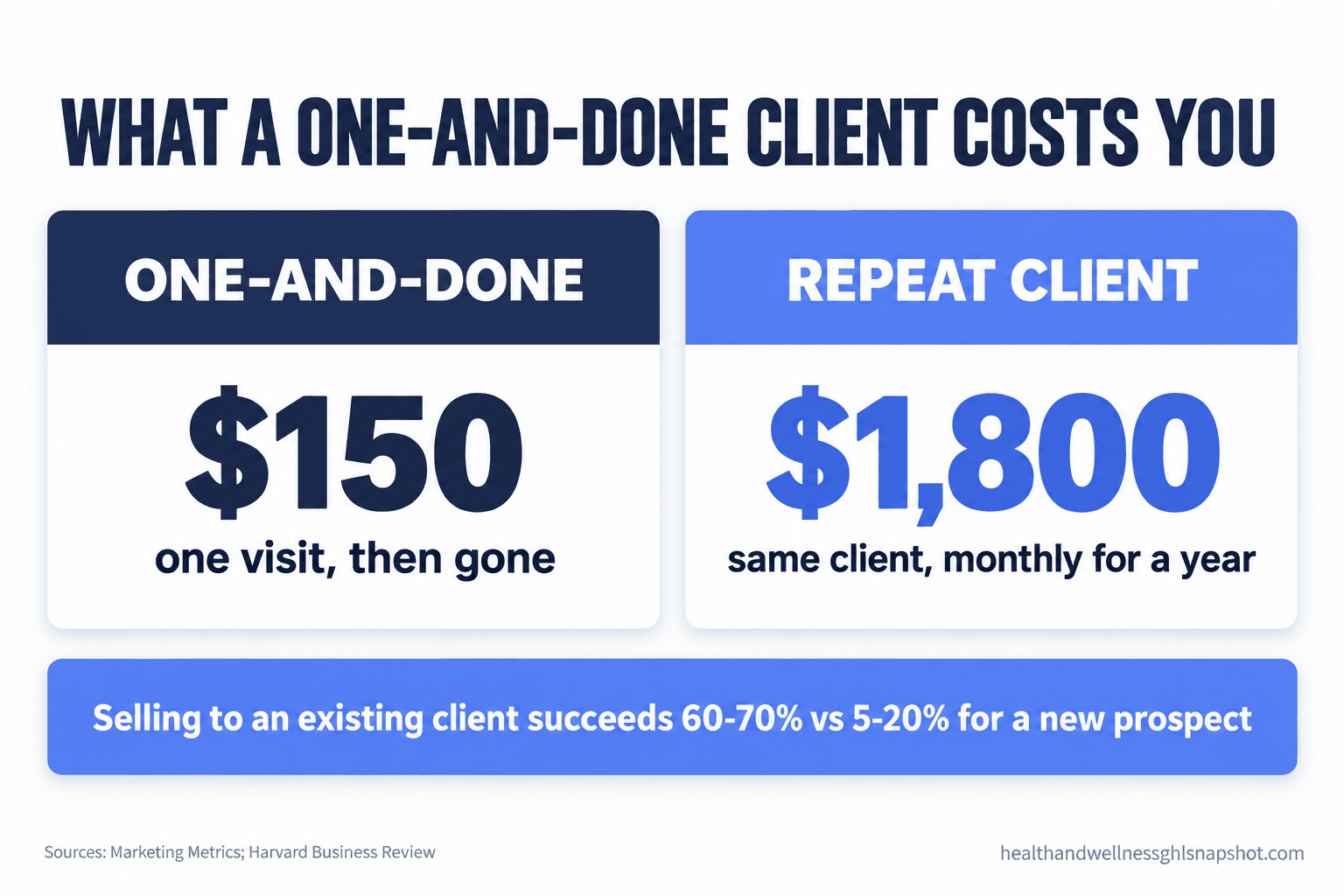
This is why retention beats acquisition on pure math. The odds of selling to a client you already have run about 60–70%, while closing a brand-new prospect sits at 5–20% (Marketing Metrics, Farris et al., via Semrush). And chasing that new prospect costs 5 to 25 times as much as keeping someone you have (Harvard Business Review).
Probability of a successful sale, existing client vs new prospect (midpoint of published ranges, %). Source: Marketing Metrics (Farris et al.), via Semrush.
The profit side is just as lopsided: Bain & Company’s work with Fred Reichheld found that raising retention by just 5% increases profits 25% to 95% (Bain via HBR). And this is a growing pond. The global IV hydration therapy market was about $2.8 billion in 2025 and is projected to reach $3.0 billion in 2026 and $5.7 billion by 2033, a 9.2% CAGR (Grand View Research). Repeat business already runs the wider med spa world too: return patients make up about 70% of med spa visits (American Med Spa Association). The demand is there. The leak is your follow-up.
Global IV hydration therapy market size, USD billions, 9.2% CAGR. Source: Grand View Research, 2025.
The six-stage repeat-visit system
A repeat-visit system is a fixed sequence of touches that starts the moment a client sits in the chair and runs until she is a monthly regular or has been politely let go. It is not a newsletter and not a punch card. It is a small set of well-timed messages, each with one job, that turn “that was great” into “same time next month.” The six stages, in order:
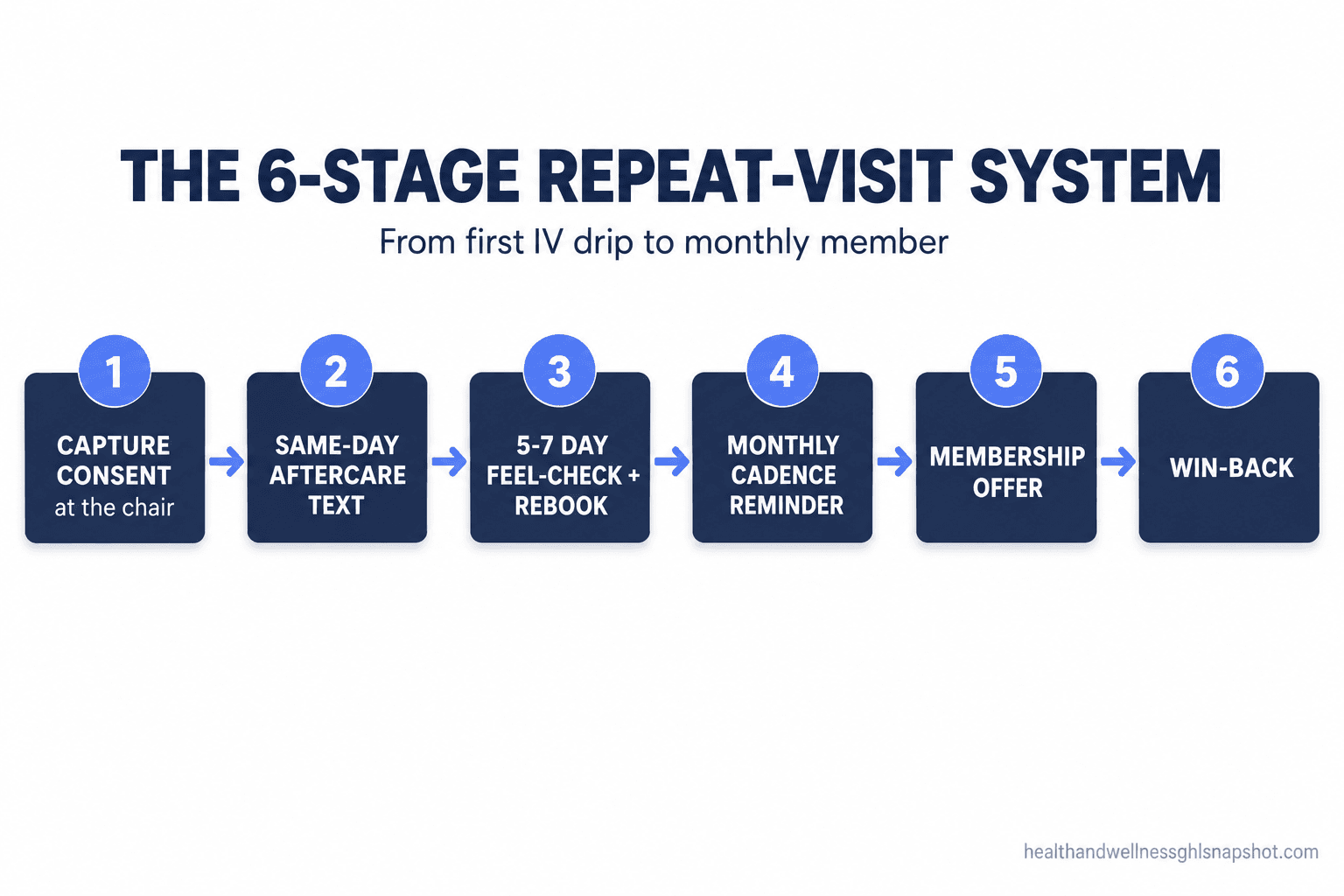
- Consent capture at the chair, so you can legally text at all.
- Same-day aftercare, the goodwill touch that opens the channel.
- The 5 to 7 day feel-check, where the rebook happens.
- The monthly cadence reminder, which keeps regulars regular.
- The membership offer, which converts repeat into recurring revenue.
- The win-back, for the client who drifts anyway.
Every stage below has the same three parts: how to set it up, the copy to send, and the failure mode that quietly kills it. The failure modes matter most, because nearly every clinic that “tried texting and it did not work” tripped one of them.
Stage 1: Capture consent at the chair
You cannot run any of this if you never captured the number with permission to text it, so consent is stage one. Get it at intake, on the same form where the client agrees to treatment. Add a clear, separate opt-in checkbox. Do not pre-check it, and do not bury it inside the treatment consent, because bundled consent is exactly what gets challenged.
Put this line on your intake form:
☐ Yes, text me appointment reminders and occasional offers from [Clinic Name]. Message and data rates may apply, message frequency varies. Reply STOP to opt out at any time. Consent is not a condition of any service.
Setup: capture name, mobile, and that checkbox on your digital intake, then pass it into your CRM tagged as SMS-opted-in. Everything downstream keys off that tag.
Failure mode: collecting the number but not the consent, or texting marketing to people who only agreed to reminders. That is a TCPA problem, and it is why carriers filter health-related texts hard. Register your texting properly (see the compliance section) and message only people who ticked the box, and your delivery stays clean. Skip it and your messages quietly stop arriving, which looks exactly like “texting does not work.”
Stage 2: The same-day aftercare text
The same-day text is not a sales message, it is a care message, and that is why it works. A few hours after the drip, while the client still feels the lift, you send a short human note. It makes your clinic feel attentive, and it warms the SMS channel so your later rebook text lands as “the place I like” instead of “a number I do not recognize.” Send it 2 to 4 hours after the appointment ends:
Hi [First name], it is [Nurse name] from [Clinic]. Thanks for coming in today. Drink plenty of water tonight and take it easy. If you have any questions about how you are feeling, just reply here and I will get back to you.
Notice what it does not say. No “boost,” no “detox,” no health promise, which keeps you clear of FTC territory while still sounding like you care.
Failure mode: sending it a day late, or making it a generic broadcast that reads like an ad. Late kills the warmth, salesy kills the trust. Tie the timing to the real appointment end, write it in your nurse’s voice, and make sure a real person sees any reply. An aftercare text that asks a question and then ghosts is worse than sending nothing.
Stage 3: The 5 to 7 day feel-check and rebook
This is the most important message in the system, because it is where the second visit is booked or lost forever. Five to seven days out, the glow has faded just enough that she remembers how much better she felt. That is the window to reach out, ask how she is doing, and make rebooking a one-tap reply:
Hey [First name], [Nurse] here from [Clinic]. How have you been feeling since your visit last [day]? A lot of our regulars come back every 3 to 4 weeks to stay on top of it. Want me to hold a spot for you this week? Reply BOOK and I will send times.
The structure matters. You ask a genuine question first, normalize the every-3-to-4-weeks cadence so a repeat visit feels standard rather than needy, and lower the effort to a single word. When she replies BOOK, your system sends live calendar times so she self-schedules in two taps. Self-booking is not optional here: it removes the phone tag that kills most rebooks, and self-scheduled appointments show up at far higher rates than staff-booked ones (the same pattern we cover in reducing no-shows).
Failure mode: sending only one nudge, or hard-selling. If she does not reply, one gentle follow-up a few days later is fine. A third is nagging. And “Book now, spots going fast” turns a warm check-in into a pushy ad. The tone is a friendly nurse asking how you feel, not a gym chasing quota.
Stage 4: The monthly cadence reminder
Once a client has come back even once, your job shifts from winning her to keeping her on a rhythm. For most IV and wellness clients a 3 to 4 week cadence is the natural interval, whether it is a Myers cocktail, a hydration drip, or a vitamin injection. The reminder does the remembering, because a busy person will not track when their last drip was, but they will act on a text that already has the booking link ready. Send it about a month after the last visit:
Hi [First name], it has been about a month since your last visit at [Clinic]. Your usual [treatment] takes about 45 minutes. Here is the link to grab a time this week: [link]. Reply STOP to opt out.
Setup: trigger the reminder off the last completed appointment date, per client, not a fixed calendar blast, so every client gets it on her own schedule and the interval can flex by treatment.
Failure mode: the wrong interval and broken time zones. Text a maintenance client weekly and you annoy her out the door. Send a multi-location clinic’s reminders in the wrong time zone and your 9am note arrives at 6am, which reads as careless. Tie the cadence to the treatment and stamp the client’s real time zone at intake. This one quiet detail separates a system that runs for a year from one switched off in a month, and it is worth reading our retention benchmarks to set the right target per program.
Stage 5: The membership offer
A membership turns a client who happens to come back into recurring revenue you can count on, and the time to offer it is after her second or third visit, not the first. By then she has proven the habit to herself, and the membership simply makes official what she is already doing, usually at a small saving that feels smart rather than salesy. Offer it after visit two or three:
[First name], you have been in a few times now and we love having you. Our monthly membership is $[X]/month and includes one drip a month plus [10% off] any add-ons. For how often you come in, it works out cheaper than paying per visit. Want the details? Reply YES.
Price it just below the per-visit total for a client who comes in monthly and you trade a little margin per drip for predictable revenue, higher retention, and a client far more likely to refer. That is the shift the whole med spa industry is making toward memberships, and it is the same logic behind pricing wellness packages rather than selling everything a la carte.
Failure mode: offering too early, or letting billing fail silently. Pitch it on the first visit and it feels like a timeshare. Once members are signed up, a failed card nobody chases is pure lost revenue, and it happens constantly. Build a failed-payment recovery flow that texts the client to update their card before you lose the member. A membership you do not defend is one you slowly bleed.
Stage 6: The win-back
Some clients drift no matter how good your system is, and the win-back is the polite automated tap on the shoulder that brings a good share of them back for pennies. Life gets busy, a client misses a month, then two, and the longer the gap the less likely she returns on her own. A single well-timed message around 60 to 90 days lapsed recovers clients you had written off:
Hi [First name], we have not seen you at [Clinic] in a couple of months and wanted to check in. If you would like to come back, here is $20 off your next visit this month: [link]. No pressure, we just miss having you in.
Setup: trigger off days-since-last-visit, cap the discount, fire it once (a second win-back a few weeks later is the most you should send), and route replies to a human.
Failure mode: training clients to wait for the discount, or texting people who opted out. If every lapse earns $20 off, your regulars learn to lapse on purpose, so keep it rare and time-boxed. Scrub your STOP list before every send, because messaging an opted-out client is both a violation and a fast way to get your number flagged. The full re-engagement timing is in our client reactivation guide.
Run it for your size: solo, three-location, mobile
The six stages are the same for every clinic, but who runs them and how they are staffed changes with your size. The framework does not bend, the operations around it do.
The solo IV bar. You are the nurse, the front desk, and the marketing department, so the one thing you cannot do is send these texts by hand. Automation is the only way the system survives a busy day. Set all six stages to fire automatically and route only the human replies (aftercare questions, BOOK confirmations) to your phone. Your job shrinks to answering the people who raise their hand, which is also where a dedicated wellness virtual assistant earns its keep.
The three-location clinic. Now the risk is inconsistency: location A sends warm, on-brand texts and location B forgets. Centralize the sequences so every location runs the identical flow, but stamp each client with their home location and time zone so the reminder says the right address at the right hour. One system, many storefronts, consistent voice, and it pairs with the software cost math of not paying per-provider fees on every seat.
The mobile or concierge service. You have no lobby to remind clients you exist, so the follow-up system is your entire retention engine. Lean harder on the aftercare and cadence texts, and add the client’s service area to the booking link so a rebook slots into your route rather than sending you across town. Here the sequence is the difference between a real business and a string of one-off bookings.
The compliance lines to respect
Automating client texts in a health setting means staying inside three lines: HIPAA, FTC health claims, and SMS carrier rules. The system above is built to clear all three, as long as you know where they are.
HIPAA. A pure cash-pay IV clinic that does not bill insurance and does not share patient data with a lab or referring physician may fall outside federal HIPAA. Do not assume it. The moment you bill insurance or share protected health information with a covered-entity partner, you are likely covered and need a signed Business Associate Agreement with any vendor touching that data. Either way, keep the text content to first names and appointment logistics, never diagnoses or lab results, and know you owe state privacy and breach-notification duties regardless. Our HIPAA-aware SMS guide goes deeper.
FTC health claims. The FTC has warned roughly 700 weight-loss and wellness marketers and sent letters to IV-therapy companies specifically over immune and COVID claims. Your texts, and your marketing generally, must not say a drip “boosts immunity,” “melts fat,” or “detoxes” without competent and reliable evidence. That is why every text here talks about how you feel and appointment logistics, not medical outcomes. Soften the claim or cut it.
SMS carrier rules. Health messaging draws heavier carrier filtering than retail, so 10DLC brand and campaign registration is not a formality, it is what keeps your texts arriving. Register your business, register your use case honestly as reminders plus marketing, honor STOP instantly, and keep opt-outs scrubbed. Do that and delivery stays healthy. Skip it and your careful sequence disappears into the filter.
Objections owners raise
“Won’t clients find the texts annoying?” Only if you send the wrong ones. There is a wide gap between a warm aftercare note from your nurse and a barrage of “book now” ads. The system above is deliberately light: one care text, one feel-check with maybe one follow-up, a monthly reminder tied to the client’s own rhythm, and a rare win-back. That is not spam, it is the attentiveness clients wish more clinics had. Annoyance comes from frequency and tone, both of which you control, and STOP is always one tap away.
“I already use Boulevard or Jane, so why do I need this?” Your booking software books and your EHR charts, but neither runs a proactive follow-up sequence that reaches out to a lapsed client on its own. Those tools wait for the client to come to them. The repeat-visit system goes to the client. It sits alongside your existing stack and does the one job those tools were never built for. Many owners run it on GoHighLevel precisely so they are not paying per-provider fees to add marketing to a clinical tool.
“Do I need to be technical to set this up?” No, but you do need it built correctly once, because the failure modes above (timing, time zones, consent, STOP handling) are exactly what trips a DIY build. Wire the sequences yourself in GoHighLevel if you enjoy that work, or install a system where all six stages, the copy, and the compliance handling are already built and simply switched on. Either way, once it is running it runs on its own.
“Isn’t IV therapy just a one-time thing for most people?” That belief keeps clinics stuck at one-and-done, and it is mostly wrong. Some first visits are situational: a hangover, a cold coming on, an event. But a real share of those people would happily come in monthly for energy, hydration, or recovery if anyone gave them a reason and a rhythm. The one-time visit is the default only when nothing follows up.
Frequently asked questions
Frequently asked questions
Why do IV therapy clients only come once?
Almost always because nothing follows up after the visit. The client feels great and leaves happy, but with no aftercare text, no rebook nudge, and no cadence reminder, there is nothing to bring them back, so they drift. It is a follow-up gap, not a loyalty problem, and it is fixable with a simple automated sequence.
How often should an IV therapy client come in?
For most maintenance clients, every 3 to 4 weeks is the natural cadence, whether it is a hydration drip, a Myers cocktail, or a vitamin injection. Situational visits (hangover, illness, an event) are one-offs, but a monthly rhythm is what turns a first-timer into a regular. Always follow the treatment guidance and let the client's own response set the interval.
What should I text a client after an IV drip?
Send a short, human aftercare note 2 to 4 hours later: thank them, remind them to hydrate and rest, and invite them to reply with any questions. Keep it free of health claims like 'boosts immunity' or 'detox.' Then, 5 to 7 days out, send a feel-check that asks how they are doing and offers to hold a rebook spot.
Is it legal to text IV therapy clients marketing messages?
Yes, if you have express consent and follow the rules. Capture a clear, unbundled SMS opt-in at intake, register for 10DLC so carriers deliver your health-related texts, honor STOP immediately, and keep clinical detail out of the message. If you bill insurance or share data with a lab, you are likely HIPAA-covered and need a Business Associate Agreement with your vendor.
When should I offer an IV therapy membership?
After the second or third visit, once the client has shown the habit. Offering on the first visit feels pushy. Priced just below the per-visit total for a client who comes in monthly, a membership trades a little margin for predictable recurring revenue and much higher retention. Build a failed-payment recovery flow so a declined card does not silently cost you the member.
Back to that Friday client. In the version where nothing follows up, she is a $150 memory. In the version with the six stages running, she gets a caring text that afternoon, a check-in a week later that rebooks her, a monthly reminder that keeps her coming, and a membership offer once the habit is real. Same client, same first drip. The only thing that changed is that this time, something asked her to come back. That is the difference between a clinic that fills the calendar every month and one that keeps starting from zero.