
You found the retail space, priced the equipment, and picked a name. Then a colleague asks the one question that stops you cold: “Wait, can you even own the clinic yourself?” You are a nurse practitioner. You are trained, licensed, and ready. And depending on which state you are standing in, the honest answer ranges from “yes, outright” to “no, not without a physician-controlled corporation.” This is the part of opening an IV bar, hormone clinic, or weight-loss practice that nobody puts on the vision board, and it is the part that decides everything else.
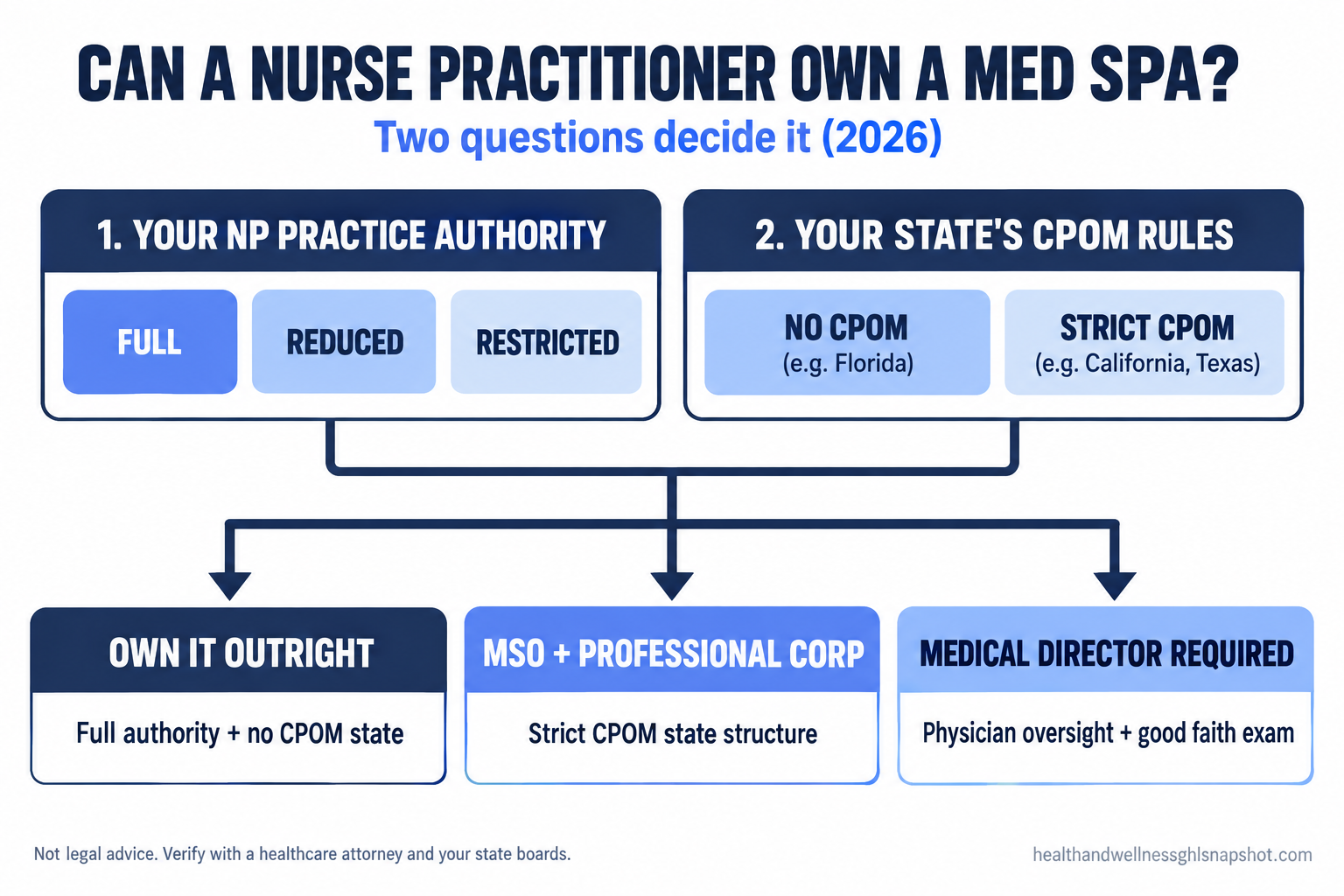
Here is the answer first. Whether you can own a med spa as a nurse practitioner comes down to two things: your state’s NP practice authority and its corporate practice of medicine (CPOM) doctrine. In a full-practice-authority state with no CPOM rule, you may be able to own the clinic outright. In a strict-CPOM state, the medical entity must be owned by a physician (or, in California from January 2026, a qualifying NP), and you participate through a management company. Below is how to figure out which world you are in, what a medical director actually costs and does, and the ownership model that fits your state.
Table of contents
- The one doctrine that decides everything: CPOM
- Question one: what is your NP practice authority?
- Question two: does your state enforce CPOM?
- Three states, three models: Florida, California, Texas
- The medical director: what they cost and must do
- Three ownership scenarios
- The delegation and paperwork checklist
- The marketing rules that also apply to you
- Objections and honest answers
- Frequently asked questions
The one doctrine that decides everything: CPOM
Corporate practice of medicine is the rule that says medicine must be practiced by licensed people, not owned by unlicensed capital. In states that enforce it, a business that delivers medical services has to be owned and controlled by a licensed clinician, so that clinical judgment answers to a professional, not to an investor. In states without it, ownership is open, but a licensed provider still has to stand behind every clinical decision.
For a med spa or IV clinic this matters because most of what you sell is medicine. Injectables, IV therapy, laser treatments, hormone protocols, and GLP-1 weight-loss programs are medical procedures, which means the ownership question is not about salons or spas, it is about who may own a medical practice in your state. That is why the same clinic can be legal for you to own in Florida and illegal for you to own alone in Texas.
CPOM is not a single national rule. It is a patchwork: some states have a strict doctrine, some have a loose one, and a few have none at all (DK Law Group on CPOM by state). Your job is to find out where your state sits, then match it to what your NP license lets you do.
Question one: what is your NP practice authority?
Your practice authority sets what you can do clinically without a physician, and it is the first thing that shapes your ownership options. The American Association of Nurse Practitioners sorts every state into three buckets.
Full practice authority lets you evaluate, diagnose, order tests, and prescribe under the authority of your board of nursing, without a career-long physician contract. As of 2026, roughly 30 jurisdictions including Washington, D.C. grant full practice authority (Nurse.org, 2026). This is the group where NP ownership is most achievable.
Reduced practice requires a career-long collaborative agreement with a physician for at least one element of practice, often prescribing. Restricted practice goes further, requiring physician supervision or delegation for you to practice at all. The exact list shifts as states pass new laws, so do not trust a number you read once. Check the current status on the AANP State Practice Environment map before you plan anything, because your bucket changes which of the models below is even open to you.
Approximate split of US jurisdictions (states plus DC) by NP practice authority, 2026. Counts shift as states pass legislation. Source: AANP and Nurse.org, 2026.
Question two: does your state enforce CPOM?
Practice authority tells you what you can do. CPOM tells you what you can own. The two are separate, and you need both answers.
Here is the trap: you can hold full practice authority and still be blocked from owning the medical entity by CPOM. Full practice authority is about clinical scope under your nursing license. CPOM is about who may hold the shares of a medical practice. A state can let you diagnose and prescribe independently while still requiring the practice itself to be a physician-controlled corporation. Do not assume that because you can treat patients, you can own the company that bills for it.
There are broadly three CPOM postures. In a no-CPOM state, a non-physician (including you) can own the entity outright, subject to registration and a medical director. In a strict-CPOM state, the medical entity must be physician-owned, and non-clinical parties use a management services organization (MSO) to run the non-clinical side while a physician-controlled professional corporation owns the clinical side. And in the middle, loose or unofficial doctrines create gray areas that only a local healthcare attorney should read for you.
Three states, three models: Florida, California, Texas
These three show the full range. Find the one your state resembles, then verify the specifics locally.
Florida: no CPOM, the most open model. Florida has no corporate practice of medicine statute, so a non-physician can own a med spa or IV therapy business outright (Florida Healthcare Law Firm). The catch is that a med spa with a non-physician owner generally must register as a Health Care Clinic with the Agency for Health Care Administration, and a licensed medical director still answers for every clinical decision. Open, but not unregulated.
California: strict CPOM, the professional-corporation model. A California med spa performing medical procedures must be owned through a professional corporation controlled by an MD, DO, or, as of January 2026, a qualifying NP under AB-890 who has completed the required transition-to-practice hours (medspastandards). Non-clinical investors participate through a management services organization. And a 2026 law, SB 351, bars MSOs from making billing, e-prescribing, or coding decisions that depend on clinical judgment, tightening the line between the business side and the clinical side. Complex, and worth an attorney’s full attention.
Texas: strict CPOM, physician-owned only. In Texas, only a licensed physician may own a med spa, because delivering medical services is the practice of medicine. Non-physicians use a PLLC-plus-MSO structure to participate (Medical Director Co on Texas CPOM). An NP or PA cannot serve as the delegating physician, and the physician must register the delegation with the Texas Medical Board under section 157.0511, with the Board of Nursing having already approved the NP’s prescriptive authority (Pabau on Texas med spa law). Texas enforcement has intensified, so the paperwork is not optional.
The medical director: what they cost and must do
In most states, whether or not you can own the entity, a med spa offering injectables, lasers, IV therapy, or GLP-1 programs needs a physician medical director and a good faith exam by a licensed provider before a patient’s first treatment (medspastandards guide). The good faith exam establishes the provider-patient relationship and confirms the treatment is appropriate, and it has to happen before that first service, not after.
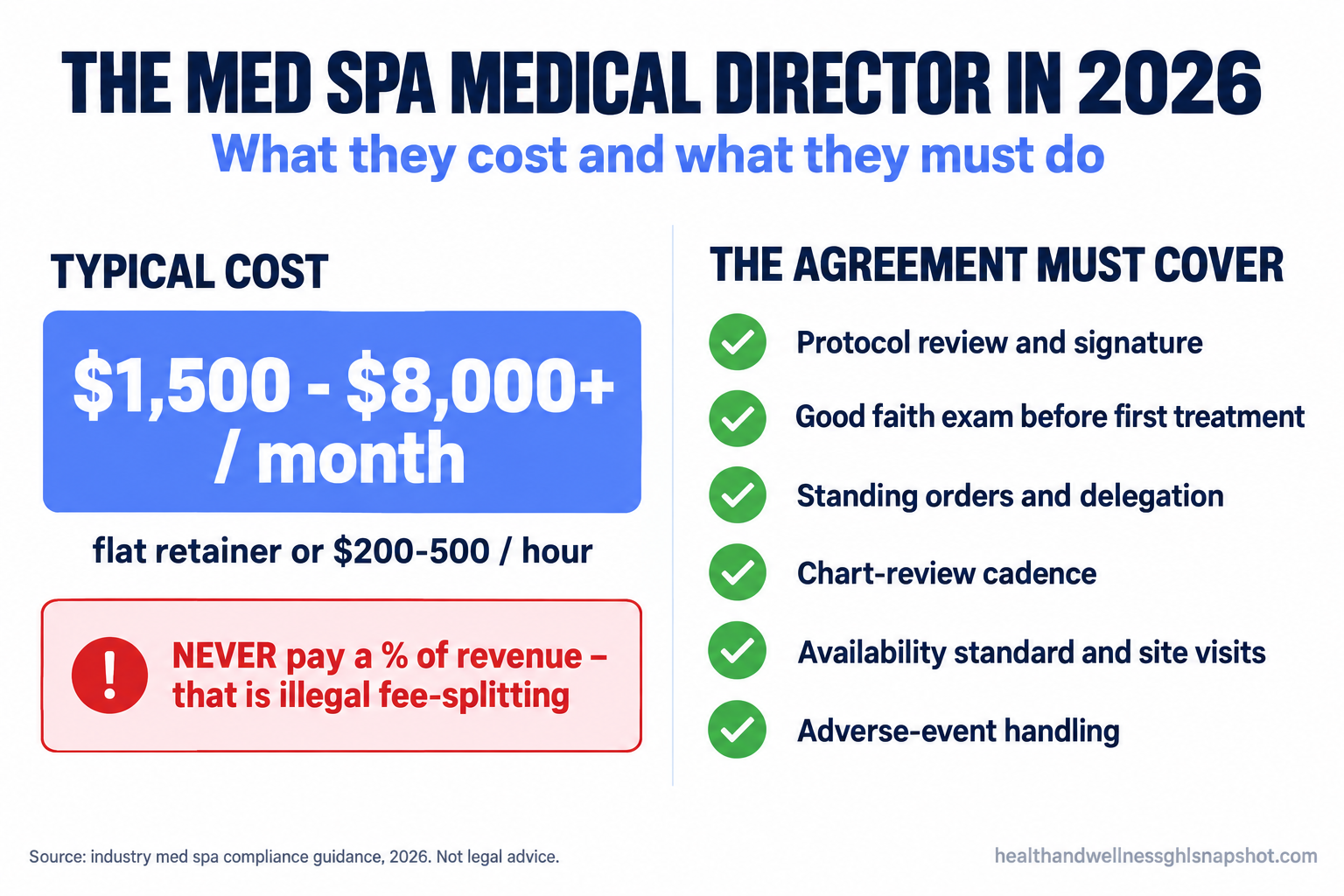
A medical director is not a name on a wall. A real agreement should cover protocol review and signature, standing orders and delegation, chart-review cadence, an availability standard, site-visit frequency, and adverse-event handling. Skip those and you have a title, not oversight.
The cost is a genuine line in your budget. In 2026, most med spa medical directors are paid a flat retainer of roughly $1,500 to $8,000-plus a month, or a documented hourly rate of about $200 to $500, depending on the state, the services, and how involved the physician is (medspastandards on cost). Light oversight sits at the low end; a director who is regularly on site and performs exams commands the high end.
Three ownership scenarios
Run your situation against these three and you will know which model you are building toward.
Scenario one: full practice authority, no-CPOM state. You hold full practice authority and you are in a state like Florida with no CPOM doctrine. This is the cleanest path: you can generally own the clinic entity yourself. You still register the clinic as your state requires, and you still arrange a medical director and good faith exams for the medical services. Your budget carries the director retainer, but the equity is yours.
Scenario two: strict-CPOM state, MSO route. You are in California, Texas, or another strict-CPOM state. The medical entity must be physician-controlled (or NP-controlled in California under AB-890), so you build a two-part structure: a professional corporation that owns the clinical side, and a management services organization that you own and that handles marketing, staffing, equipment, and operations under a management agreement. This is legal and common, but it must be drafted by a healthcare attorney so the MSO never crosses into clinical decisions, especially after California’s SB 351.
Scenario three: the non-clinical partner. You are partnering with a non-clinical investor, or you are the non-clinical owner working with a contracted physician. In a no-CPOM state this can be a direct ownership stake; in a strict-CPOM state the non-clinical partner sits in the MSO, never in the professional corporation. Either way, the clinical control and the medical director relationship stay with a licensed provider. Get this line right on day one, because unwinding it later is expensive.
The delegation and paperwork checklist
Whatever your model, the same documents keep coming up. Build this file before you open, not after your first inspection.
- Entity formation for the correct structure (PC, PLLC, MSO) as your state requires.
- State clinic or facility registration (for example, Florida’s Health Care Clinic license) and any laser or radiation permits.
- Medical director agreement with the six elements above, at fair market value.
- Written delegation and standing orders, registered with the board where required (Texas requires TMB registration under section 157.0511).
- Good faith exam protocol that runs before every patient’s first treatment.
- Prescriptive authority confirmation from the board of nursing for any NP prescribing.
- HIPAA and privacy documentation, including a business associate agreement with any vendor that touches protected health information.
Store these where your team can find them, keep them current, and review the whole file annually against your state’s latest rules, because the rules move.
The marketing rules that also apply to you
Getting the ownership right is step one. The rules that govern how you talk to clients apply no matter who owns the entity, and they carry real penalties.
HIPAA depends on your billing. If your clinic bills insurance or shares protected health information with a covered-entity partner like a lab, you are a covered entity and your systems and messaging must be HIPAA-compliant with a signed business associate agreement. A pure cash-pay IV bar may fall outside HIPAA but still owes state privacy and breach-notification duties. For the messaging side, see our guide to HIPAA-aware SMS.
FTC health claims are strictly enforced. Copy that says a drip “boosts immunity,” “melts fat,” or “detoxes,” or that implies your compounded product equals a brand-name GLP-1, needs competent and reliable evidence or must be softened. And because the FDA declared the semaglutide and tirzepatide shortages resolved in 2024 and 2025, “the shortage” is no longer a valid compounding justification in 2026. Health-related SMS also draws heavier carrier filtering, so 10DLC brand registration matters here. Once your structure is sound, the software you run on top of it (covered in our teardown of what med spa software actually costs) should respect every one of these lines.
Objections and honest answers
“I have full practice authority, so I can own any clinic, right?” No. Practice authority is your clinical scope; CPOM is about ownership. In a strict-CPOM state you can practice independently and still be barred from owning the medical entity directly. They are two separate questions and you need both answers.
“Can’t I just skip the medical director if I’m the NP running it?” It depends entirely on your state and services. In some full-practice states an NP owner may not need a physician director for NP-scope services, but many medical treatments still require physician involvement or a good faith exam protocol. Never assume you are exempt. Confirm it in writing with your board and attorney.
“An MSO sounds like a loophole. Is it legit?” Yes, the MSO-plus-professional-corporation model is a standard, legal structure in strict-CPOM states. It stops being legit when the MSO starts making clinical decisions or when the pay looks like fee-splitting. Drafted correctly by a healthcare attorney, it is how most multi-owner clinics are built.
“This is a lot of cost before I’ve seen a single client.” It is, and that is the honest math of medical ownership. Between the medical director retainer and the legal setup, plan for real money up front. The upside is that the average med spa location earned $1,398,833 in 2024, so the structure pays for itself when the clinic is built on solid ground rather than a shortcut you unwind later.
Frequently asked questions
Can a nurse practitioner own a med spa?
It depends on two things: your state's NP practice authority and its corporate practice of medicine rules. In a full-practice-authority state with no CPOM doctrine, such as Florida, an NP can generally own the clinic entity outright. In a strict-CPOM state like Texas, the medical entity must be physician-owned, and in California a qualifying NP can own a professional corporation under AB-890 from January 2026. Always confirm with a healthcare attorney in your state.
What is the corporate practice of medicine doctrine?
CPOM is the legal principle that medicine must be owned and controlled by licensed clinicians rather than by unlicensed investors, so that clinical judgment answers to a professional. States enforce it to different degrees: some strictly, some loosely, and a few not at all. It is the main reason the same med spa can be legal for a non-physician to own in one state and illegal in another.
Does a med spa always need a medical director?
In most states, a med spa offering injectables, lasers, IV therapy, or GLP-1 programs needs a physician medical director and a good faith exam before a patient's first treatment. Whether an NP owner personally needs a director for NP-scope services varies by state. Confirm the requirement with your state medical and nursing boards before you open.
How much does a med spa medical director cost in 2026?
Most medical directors are paid a flat retainer of roughly $1,500 to $8,000 or more per month, or a documented hourly rate of about $200 to $500, depending on the state, services, and involvement. Compensation must be fair market value and must never be a percentage of revenue or a per-treatment fee, which is illegal fee-splitting.
What is an MSO and why do med spas use one?
A management services organization is a business you can own that handles the non-clinical side of a clinic (marketing, staffing, equipment, operations) under a management agreement with a physician-controlled professional corporation that owns the clinical side. In strict-CPOM states it is the standard, legal way for non-physicians and NPs to participate in a med spa without violating ownership rules.
Is New York a full practice authority state for NPs?
New York expanded NP practice authority, and 2026 sources list it among full-practice jurisdictions for qualifying NPs, but corporate ownership of a medical practice is a separate question governed by New York's own professional-entity rules. Because these rules are nuanced and change, verify both your practice authority and the ownership structure with a New York healthcare attorney before planning a clinic there.
The ownership question feels like a wall, but it is really just two questions with findable answers: what your NP license lets you do, and what your state lets you own. Answer those, build the right structure with a healthcare attorney, and budget honestly for the medical director. Do that and you are not gambling on a shortcut. You are building a clinic that can grow, hire, and eventually sell, on ground that holds.