
It’s a Tuesday and a RepeatMD rep is on your calendar. The deck is good: a branded app with your logo, members buying injectable packages from their phone, points that pull them back in, recurring plans that smooth out your slow weeks. Then you ask the one question your bookkeeper told you to ask: what does this cost me, all in, per month. The rep says it depends on your practice and promises a custom quote. The call ends and you still can’t put a number in your budget.
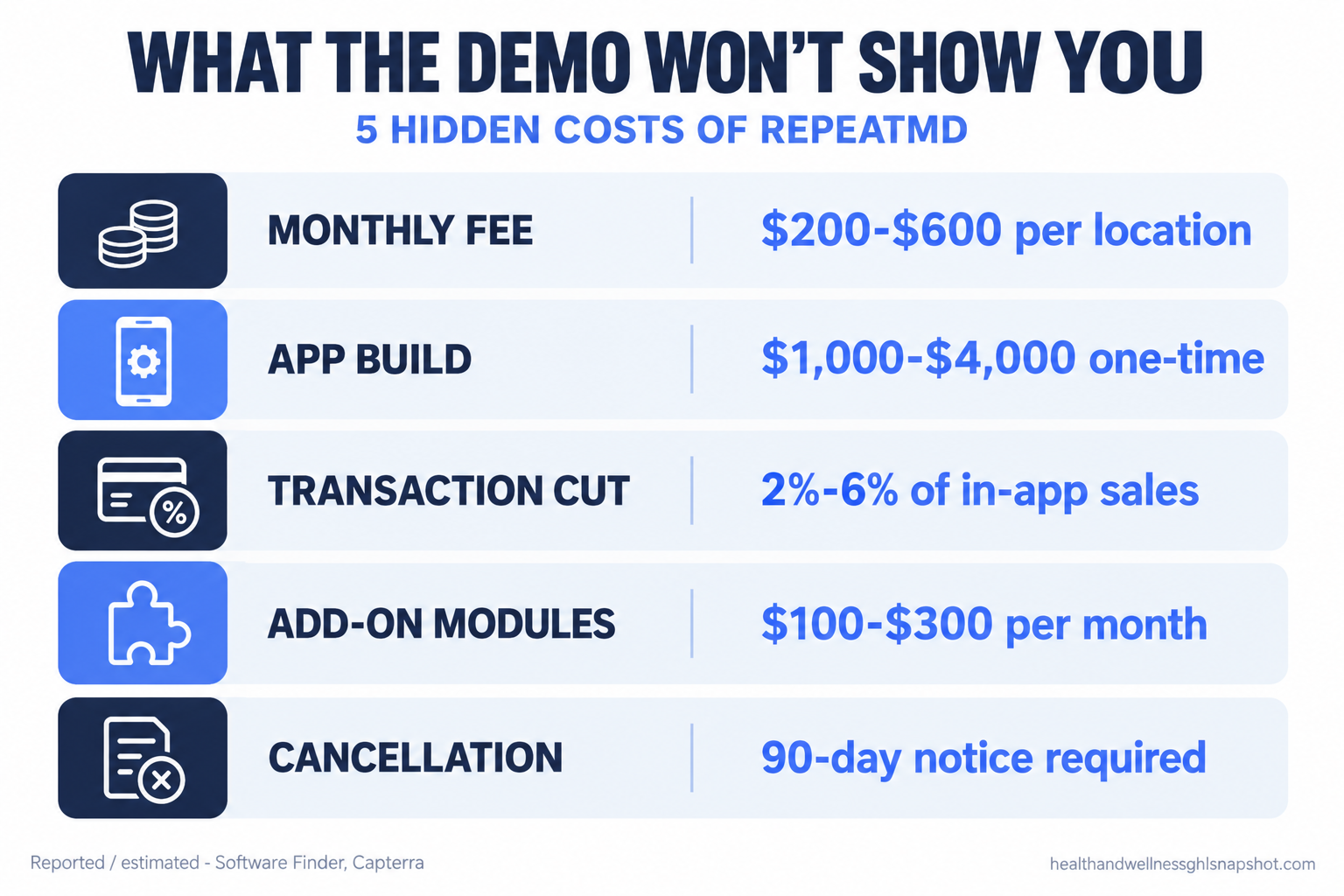
Here is the honest answer up front: RepeatMD publishes no price, and that is the game. Third-party listings put it at roughly $200 to $600 per location per month, with a one-time app build of about $1,000 to $4,000, plus a transaction cut of around 2% to 6% on everything members buy through the app (Software Finder). One competitor reports the processing fee as 3.99% plus $0.30 per transaction (Cherry). It is not your booking or charting system; it is a membership and e-commerce layer you bolt on top of whatever you already run (Pabau). So you are adding a subscription, a setup bill, and a slice of your own sales on top of software you already pay for. Below is every line of that invoice and the math for three clinic shapes.
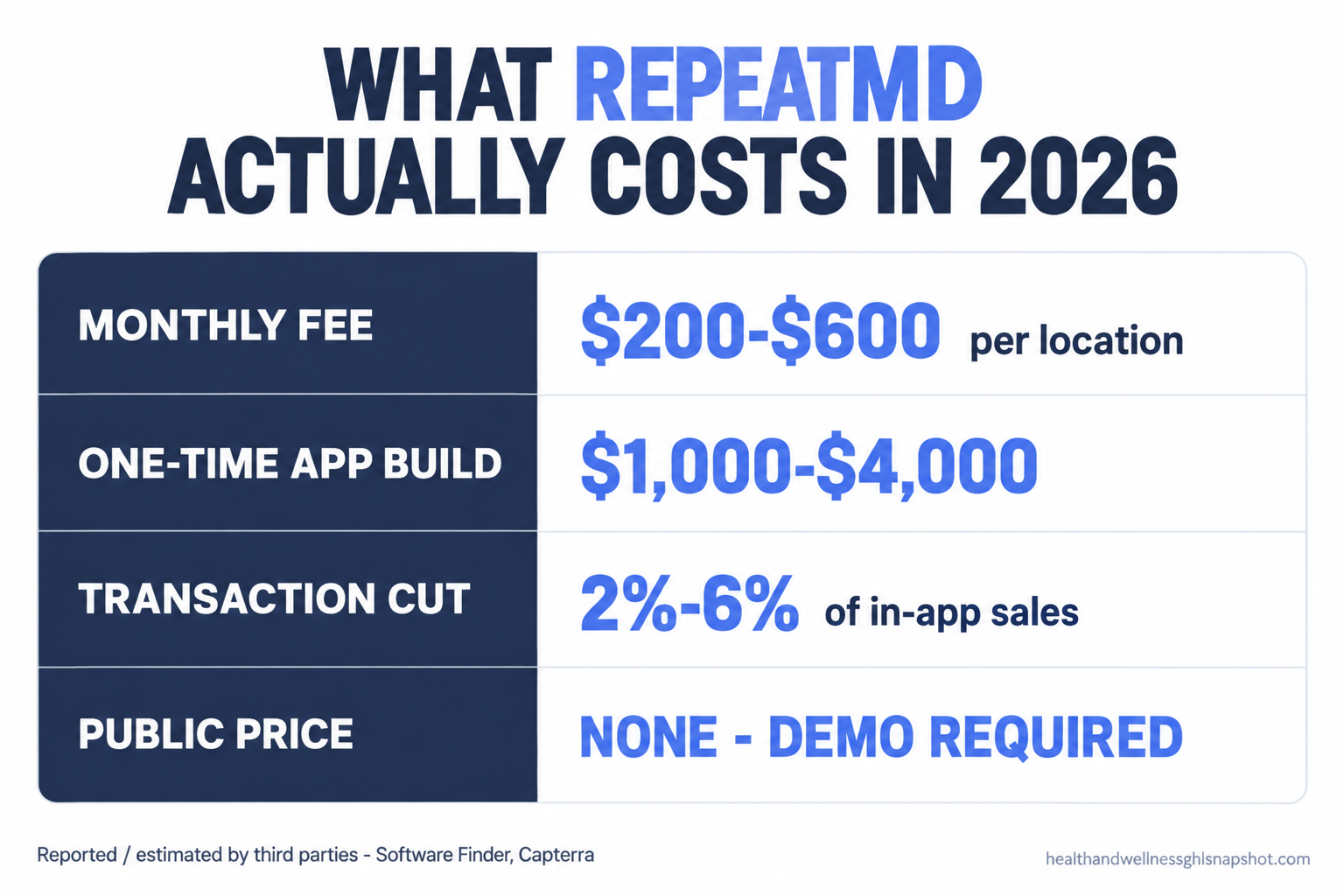
Table of contents
- Why the demo ends without a price
- What one-and-done clients cost you while you shop
- What RepeatMD actually is, and what it is not
- The eight things that decide your RepeatMD bill
- The reported 2026 numbers, and why they’re all over the map
- The contract and the exit
- What a solo IV bar, a three-location clinic, and a larger group each pay
- Where RepeatMD quietly breaks
- Steal this: the questions and the member sequence
- Compliance corner: HIPAA, the FTC, and SMS
- Common objections, answered honestly
- The bottom line
- Frequently asked questions
Why the demo ends without a price
When a vendor makes you book a call to learn the price, the price is a negotiation, not a number. RepeatMD lists no pricing table. Capterra shows it as contact-vendor-for-pricing with no free trial, and an independent listing describes the model as demo-based (Capterra). That tilts the deal toward the rep, and it matters more here than with your booking software, because RepeatMD’s price is partly a cut of your sales, the part a demo glides past. Force the all-in number out in writing, including the transaction rate, before you sign.
If you’re shopping for the clinical record that holds charts and orders, that is a different shelf of software, and we drew that line in our Cerbo vs Healthie comparison. This piece is for the owner of an IV, injectable, or weight-loss clinic, often a nurse practitioner running one to three locations, weighing whether a membership app earns its keep on top of the tools they already run.
What one-and-done clients cost you while you shop
The subscription is a cost. The leaking revenue it’s meant to fix is usually bigger.
Per the American Med Spa Association’s 2024 report, the average single med-spa location earns about $1,398,833 a year, and repeat patients now make up 73% of visits, up from 65% (AmSpa). The IV side keeps growing too, with the market near $3.0 billion in 2026, up 9.2% a year (Grand View Research). The money is in the return visit, and RepeatMD’s pitch is that an app with points and plans makes it happen. The pitch isn’t wrong: a one-time IV client who never rebooks is pure lost revenue, and we walk the reasons in why IV therapy clients only come once. The narrower question is whether a branded app charging a monthly fee plus a slice of each sale is the cheapest way to turn that client into a member, or the most expensive. That depends on the numbers RepeatMD won’t show you.
What RepeatMD actually is, and what it is not
RepeatMD is a membership and e-commerce layer, not a practice-management system. Buy it expecting an all-in-one and you’ll be double-billed.
By the listings, it runs a branded patient app and storefront, membership plans with automated billing, a points-and-rewards program, AI treatment recommendations, and Affirm financing (Software Finder, Pabau). What it does not do matters just as much: no clinical notes or EHR, no scheduling engine, no prescriptions, no insurance billing. You still run Boulevard, Aesthetic Record, Jane, or Cerbo underneath it to chart and book. RepeatMD sits on top and sells plans, so it’s an addition, not a replacement, the fact most owners miss when they compare its fee to their current software. Our med-spa software cost teardown lays the core platforms side by side.
The eight things that decide your RepeatMD bill
The monthly sticker is one line. These eight items are where the real money hides, and the transaction cut and the contract are the two that surprise owners.
| What you are comparing | RepeatMD (reported / estimated) |
|---|---|
| Public pricing | None; demo-gated, “custom” quote only |
| Monthly fee | ~$200–$600 per location/mo (benchmark) |
| One-time app build / onboarding | ~$1,000–$4,000 (reported) |
| Transaction cut on in-app sales | ~2%–6%; a competitor cites 3.99% + $0.30 |
| Free trial | None; demo only |
| Contract | Reported long lock-in, 90-day cancel notice |
| What’s bundled | App, memberships, rewards, financing, AI recs |
| What’s missing | EHR, charting, scheduling, prescriptions |
Sources: Software Finder (price estimates), Cherry (processing fee, competitor), Pabau (features, competitor), Capterra (contract reports). RepeatMD publishes no price; confirm every figure in writing.
The reported 2026 numbers, and why they’re all over the map
No vendor price means every figure in circulation is someone’s estimate or one owner’s invoice, and they disagree by an order of magnitude. That spread is the story.
On the monthly fee, Software Finder calls $200 to $600 per location a benchmark; one Capterra user reported about $700, and a third listing showed flat fees as low as $79 to $99 (Software Finder). Those can’t all be the same deal, so the number is clearly set case by case, against your revenue. On the app build, Software Finder estimates $1,000 to $4,000 to stand up your branded app, with one reviewer reporting near $5,000, plus another estimated $100 to $300 a month in modules.
Then the line that grows with you: the transaction cut, estimated at 2% to 6% of in-app purchases, memberships, gift cards, and financing. Cherry, a direct competitor, states RepeatMD charges 3.99% plus $0.30 per transaction (Cherry). Even at the low end, a clinic running $20,000 a month in app sales hands over $400 to $1,200 on top of the subscription. That is what makes RepeatMD cheap-looking and expensive-feeling.
On reputation, Capterra shows about 4.4 out of 5 from roughly 190 reviews, with praise for the patient app and membership tools (Pabau). The complaints are the useful part, below.
The contract and the exit
The expensive surprise with RepeatMD is rarely the monthly fee. It’s the contract.
Reviewers describe a lock-in harder to leave than the demo suggests: one Capterra account describes a roughly four-year commitment tied to a small signup discount, others report a required 90-day cancellation notice, and at least one says billing continued for months after they cancelled in writing (Capterra). These are individual accounts, not published terms, so verify your own, but the pattern is consistent enough to raise in the negotiation. A membership app is sticky by design, because your clients’ plans and payment methods live inside it, so pin down the term, the auto-renewal, the notice date, and the cost to leave before you sign.
What a solo IV bar, a three-location clinic, and a larger group each pay
One product, three real shapes, and the right answer changes with each. Every figure below sits on top of the booking and charting software you already pay for.
Scenario 1: solo cash-pay IV bar, one location
You run drips and a few injectables and want recurring revenue without hiring. At the reported band that’s roughly $200 to $400 a month plus a $1,000 to $4,000 app build, so year one lands around $5,000 to $9,000 before the transaction cut. For a single chair doing modest app volume, that build cost and long contract are hard to justify, and unless the branded app itself is the selling point, a one-location bar usually overpays. Our guide to turning one-time IV clients into members shows the sequence that does most of this without an app store.
Scenario 2: three-location hormone and weight-loss clinic, nurse-practitioner owned
This is where the pitch is strongest and the bill climbs fastest. Three locations across the band is $600 to $1,800 a month, or $7,200 to $21,600 a year, plus the build, modules, and 2% to 6% of everything sold across all three sites. If clients genuinely use the app and member spend is high, the cut can pencil out against retained revenue; if adoption is patchy, you’re paying a percentage on clients who’d have rebooked anyway. Model your real adoption rate before you believe the ROI slide.
Scenario 3: larger group, injectables plus memberships at scale
At five or more locations you’re in fully negotiated territory, and the transaction cut dominates: a group processing hundreds of thousands a month is handing over real money, so the question shifts from subscription price to whether you want a third party taking a percentage of your core revenue forever. Many groups this size weigh the lifetime transaction cost against owning the membership layer outright, using the framework in our membership pricing and margin math post.
Illustrative monthly subscription only, at the midpoint of the reported $200–$600 per-location band. Excludes the one-time app build ($1,000–$4,000), modules, and the 2%–6% transaction cut, which rises with your sales. Source: Software Finder.
Where RepeatMD quietly breaks
Every tool has failure modes the demo skips. These cost clinics money.
It breaks on app adoption. The whole value depends on clients downloading a branded app, and reviewers note the experience is best on iPhone and weaker on Android (Capterra). If half your clients never install it, you’re paying to reach the half that would have rebooked anyway. The fix: ask the rep for app-install rates from clinics your size.
It breaks on the transaction cut at scale. A percentage of sales feels painless at low volume and becomes your most expensive line as you grow, and unlike a flat fee you can’t cap it. The fix: model the cut at your 12-month revenue target.
It breaks on the contract. The lock-in and 90-day notice reviewers describe mean a tool that underperforms still bills you for a long time, and reports of thin post-sale support make that worse (Capterra). The fix: treat the term as a negotiation point.
Steal this: the questions and the member sequence
Compliance corner: HIPAA, the FTC, and SMS
Three things here cost owners more than any subscription: a contract you didn’t read, a HIPAA gap you assumed away, and a marketing claim you can’t back up.
On HIPAA, don’t assume the exemption. If you bill insurance or share protected health information with a lab or referring physician, you’re almost certainly a covered entity and need a signed Business Associate Agreement with any platform holding client data (HHS). A cash-pay IV bar may fall outside federal HIPAA but still owes state privacy duties. Either way, confirm RepeatMD signs a BAA at your tier first.
On marketing claims, the app will happily blast promotions, and the FTC is watching this niche: it issued Notices of Penalty Offenses to nearly 700 health-product marketers in 2023 (FTC) and has warned IV-therapy companies over immune claims. Keep “boosts immunity,” “melts fat,” and “detoxes” out of your automated copy unless you hold competent and reliable evidence. With GLP-1, the FDA declared the semaglutide and tirzepatide shortages resolved in late 2024 and early 2025, so “shortage” is no longer a valid reason to compound in 2026 (FDA). Health-related SMS also draws heavier carrier filtering, so clean 10DLC consent matters more here than in retail, which our HIPAA-aware SMS guide covers.
Common objections, answered honestly
“They hid the price. Isn’t any number you quoted basically a guess?” The per-location band, the app-build range, and the transaction cut are reported consistently across listing sites, so they’re solid directional figures. The point is to arm you to pressure-test the rep’s number, especially the transaction rate the demo won’t volunteer.
“My clients love the branded app. Isn’t that worth it?” Maybe, if adoption is genuinely high and member spend is large. The honest test is your real install rate and your repeat rate without the app. If the clients using it are mostly the ones who’d rebook anyway, you’re paying a percentage for behavior you already had.
“I already pay for Boulevard. Does RepeatMD replace it?” No. It has no charting, scheduling, or prescriptions, so it sits on top of Boulevard, not instead of it: a second subscription plus the transaction cut, the stacking most owners miss (Pabau). If your goal is recurring revenue, compare the all-in RepeatMD cost against building the membership layer once, which we cover in running a clinic membership without a $300 add-on.
The bottom line
You couldn’t put a number in your budget because RepeatMD didn’t want you leaving with one. So decide on what you can pin down. It is a capable membership app with a real fan base, and also a demo-gated monthly fee, a four-figure app build, a 2% to 6% cut of your own sales, and a contract reviewers warn is hard to leave. For a high-volume clinic whose clients truly live in a branded app, it can earn its keep. For most solo and small clinics, the same recurring revenue comes from a few well-timed sequences and membership billing on a system you own, not rent by the location and the transaction. To see how much runs on a one-time install instead of a percentage of every sale, book a quick demo. For what the core platforms underneath it cost, start with our med-spa software cost teardown.
Frequently asked questions
How much does RepeatMD cost per month in 2026?
RepeatMD does not publish pricing. Third-party listings put it at roughly $200 to $600 per location per month, though one user reported about $700 and another showed flat fees near $79 to $99. On top is a one-time app build of about $1,000 to $4,000 and a transaction cut of about 2% to 6% on in-app sales. Get the all-in number in writing.
Is there a RepeatMD setup or app-build fee?
Yes. Listings describe a one-time fee to stand up your branded app, configure rewards, build the catalog, and train staff, estimated at $1,000 to $4,000, with one reviewer reporting a build near $5,000. Confirm the exact figure before signing.
Does RepeatMD take a percentage of my sales?
Reportedly yes. Software Finder estimates a 2% to 6% cut of processed volume on in-app purchases, memberships, gift cards, and financing, and a competitor states RepeatMD charges 3.99% plus $0.30 per transaction. This cost grows with revenue, so model it at your target volume and get the rate in writing.
Does RepeatMD replace my booking or charting software?
No. It is a membership, loyalty, and e-commerce layer with no clinical charting, scheduling, prescriptions, or insurance billing. You still run a core platform such as Boulevard, Aesthetic Record, Jane, or Cerbo underneath it, so it is an added subscription, not a replacement.
What do reviewers complain about with RepeatMD?
It rates about 4.4 out of 5 on Capterra across roughly 190 reviews, with praise for the patient app and membership tools. The recurring complaints are opaque pricing, a weaker Android experience, thin post-sale support, and a long contract with a 90-day cancellation notice, including a report of billing that continued after cancellation.
This article is general information, not legal, medical, or compliance advice. RepeatMD publishes no public pricing; every price here is reported or estimated by third parties as noted, some of them competitors, and changes often, so confirm current figures and terms in writing before purchasing. Each practice is responsible for its own HIPAA, TCPA, FTC, and state-licensing obligations.