
It’s a Saturday in your IV bar and you have not sat down since you unlocked the door. Twenty-eight appointments on the board, the phone never stopped, your tech ran drips back to back, and you skipped lunch twice. By close you are wiped out, the kind of tired that feels like you earned something. Then you pull the day’s deposit report, and the number is fine. Just fine. Not the number a day that busy should produce. You did the work of a packed clinic and brought home the money of a slow one. If you have felt that exact gap between how hard the day felt and what it actually paid, you are not bad at your job. You are running a clinic that is busy but not profitable, and those are two completely different things.
Here is the honest answer up front: being fully booked is a measure of your hours, not your money. A clinic earns on two things a busy schedule does not guarantee, the revenue it pulls from each booked hour and how many of those clients come back. You can pack the board with low-ticket, one-and-done visits, free consults that never convert, and no-shows you prepped for, and end the year exhausted and flat. The fix is almost never more marketing. It is plugging the six places a busy clinic quietly leaks revenue, so the schedule you already have pays what it should. This piece names all six, runs the real math for three clinic shapes, and hands you the exact rebooking, membership, and recovery copy that turns a busy board into a profitable one.
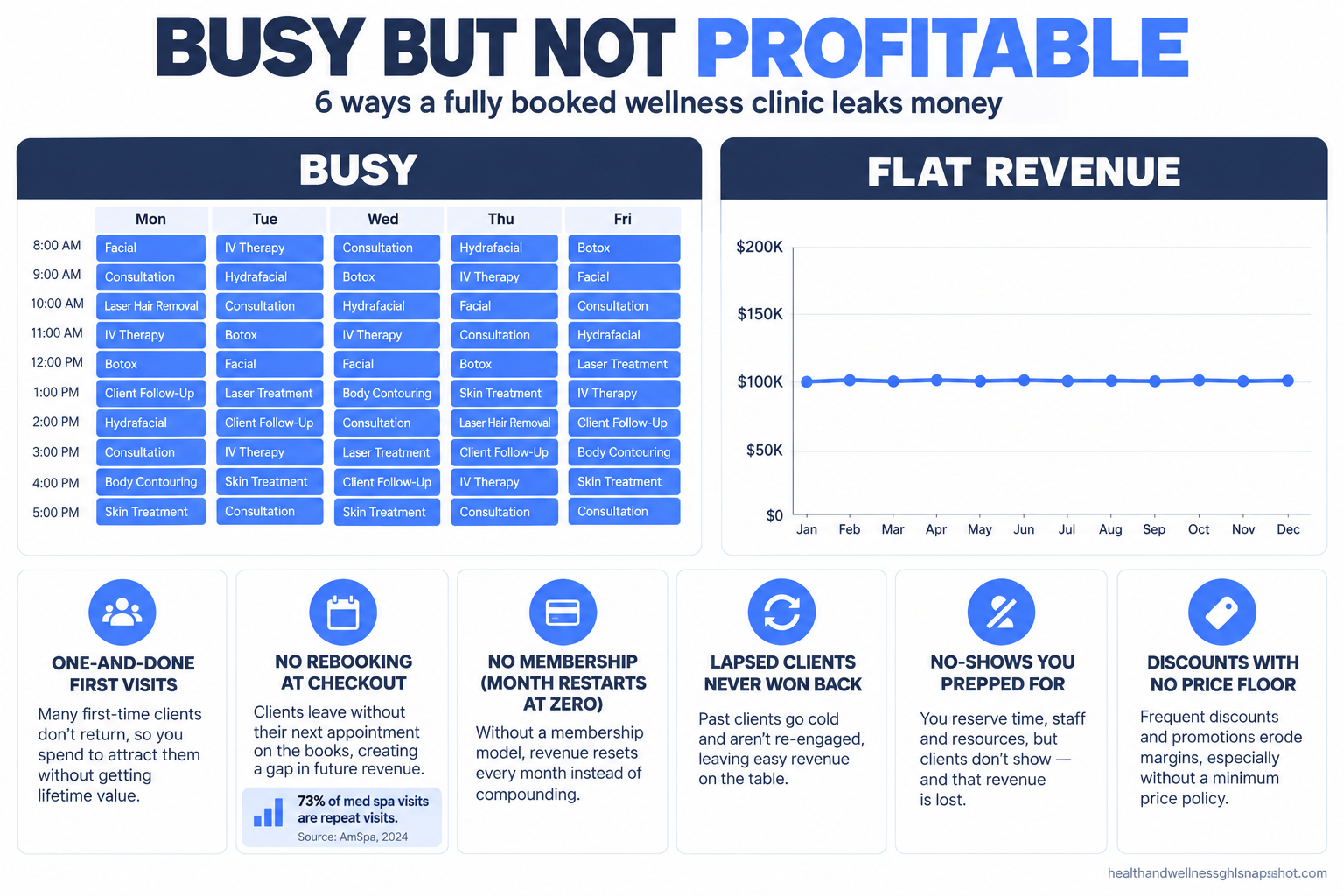
Table of contents
- Busy is not the same as profitable
- The six places a busy clinic leaks money
- Three clinics, three hidden annual leaks
- The copy that turns a busy board into a profitable one
- The compliance rules before you automate any of this
- Common objections, answered honestly
- Frequently asked questions
Busy is not the same as profitable
Start with the one number most owners never calculate: revenue per booked hour. You know your day was busy because the board was full. What you usually do not know is what each of those filled hours actually earned after you count the comped consults, the discounts, the prepped supplies that walked out the door with a no-show, and the slots that will never repeat. Busy is an input. Revenue per booked hour is the output, and the two drift apart fast in this niche.
The reason they drift is that your business is built on repeat visits, not first visits. About 73% of med spa patients are repeat patients, up from 65% in the prior report (AmSpa). That is the whole model. A first visit is a sample. The money is in the second, third, and twentieth. So a schedule that looks identical on paper, 28 appointments, can be worth wildly different amounts depending on how many of those 28 ever come back.
Now look at what happened across the industry in 2025, because it names the trap precisely. Headline med spa revenue grew about 8%, but same-location revenue grew only 2%. Almost all of the growth came from new locations opening, not from existing clinics getting more out of the clients they already had (Zenoti). In the same data, new guest visits fell 11% and even existing guest visits slipped 2%. Translated: clinics are working just as hard, seeing fewer new faces, and squeezing almost nothing extra out of the regulars. That is the busy-but-flat year, measured.
Appointment cancellation rate by how many times a med spa guest has been rebooked, from Zenoti’s 2026 medspa benchmark. A guest rebooked only once still cancels 37% of the time; a guest rebooked twice or more cancels at just 4%. The habit forms on the second and third visit, which is exactly where busy clinics stop paying attention. Source: Zenoti.
The backdrop is a big one, which makes the leak expensive. Average annual revenue per med spa location is about $1,398,833, up from $1,307,587, on an average spend of $527 per visit (AmSpa), and the IV hydration segment alone is projected near $3.0 billion in 2026 at a 9.2% CAGR (Grand View Research). On a seven-figure location, a few points of revenue per hour you never captured is a five-figure gap you never saw. The money is not missing from the market. It is leaking out of your own schedule.
The six places a busy clinic leaks money
Pull one busy day apart and the leaks appear. None of them look dramatic on the day. Each is a small, repeated loss that your deposit report hides because the board still looked full. Here are the six, in the order they usually do the most damage, each with the math and the way clinics underestimate it. Fix only the first and you leave the other five running.
Leak 1: First visits that never become a second visit
The one-and-done is the biggest leak in the building. A new client books a $200 drip, has a fine experience, and you never see them again. On the day, that reads as a win, a booked slot delivered. In reality it is the most expensive kind of visit you can run, because you paid the full acquisition cost, the ad or the referral or the front-desk time, and collected a single ticket against it. Your model only works when that first visit repeats, and 73% of the industry’s visits are repeat visits for exactly that reason (AmSpa).
How clinics underestimate it: they count the first visit as revenue and stop. The honest way to count a first visit is as a cost you have not recovered yet. It only turns into profit on visit two. We go deep on this exact pattern in why IV therapy clients only come once, but the short version is that the gap between a one-time client and a repeat one is not the experience, it is whether anything reached out to bring them back.
Leak 2: No rebooking at checkout
The emptiest slot on next week’s board is the one you created today. The single best moment to book a client’s next visit is while they are standing at your desk, still feeling the benefit, card already out. Most busy clinics skip it. The front desk is slammed, the client says “I’ll call to schedule,” and they never do. You just manufactured a future gap with your own hands.
The data on this is blunt. A guest rebooked only once still cancels 37% of the time, while a guest rebooked twice or more cancels at just 4% (Zenoti). Getting the next appointment on the calendar, and the one after that, is what converts a casual client into a reliable one. The habit is the asset.
How it breaks: rebooking at checkout dies the moment the clinic gets busy, which is the moment it matters most. If it depends on a tired front desk remembering to ask, it will not happen on your busiest days. It has to be a step in the flow, a prompt on the screen and an automatic follow-up for anyone who leaves without booking, not a thing you hope someone says.
Leak 3: No membership, so every month restarts at zero
Without recurring revenue, a busy January tells you nothing about February. Every month you start from an empty board and rebuild it from scratch with marketing and hustle. A membership flips that. It turns your best clients into predictable monthly revenue that shows up whether or not you had time to post this week. Membership is the single clearest trend in the category right now, with medspa membership sales up 13% year over year (Zenoti), precisely because owners are tired of the monthly reset.
How it breaks: owners assume a membership needs a $300-a-month software add-on and a complicated billing stack, so they never launch one. It does not. You can run recurring billing and the benefits cleanly on tools you already pay for, which we walk through in how to run a clinic membership without the add-on and the margin math in med spa membership pricing. The leak is not the software cost. It is the month you spend rebuilding revenue you could have banked.
Leak 4: Lapsed clients you never win back
You are sitting on a list of people who already liked you and simply drifted. Every busy clinic has them, the client who came three times last spring and then life got busy. They are not angry. Nobody did anything wrong. They just fell out of the rhythm, and because you were slammed, nobody noticed or reached back out. That list is the cheapest revenue you will ever find, because the trust is already built. You are not acquiring, you are reminding.
How it breaks: reactivation is always the thing that gets done “when things slow down,” and things never slow down. So the list grows and goes colder every month. The clinics that win these clients back do it with an automatic sequence that watches for a gap in a client’s visit pattern and reaches out before they are fully gone, not a once-a-year “we miss you” blast. We lay out the full approach in the client reactivation and win-back playbook.
Leak 5: No-shows and late cancels you prepped for
In a procedure clinic, an empty chair costs more than a missed ticket. When a booked client does not show, you lose the visit, but you also lose the prepped IV bag or the drawn-up injectable you can no longer re-shelf, the staff hour you paid for, and often a walk-in you turned away to protect the slot. On a busy board those gaps hide in plain sight because the rest of the day was full. They are a direct subtraction from revenue per booked hour.
How it breaks: a single reminder is not a system. The clinics that keep no-shows low run a confirmation cadence, tie prep to a same-day confirm so supplies are not wasted, and backfill the gap from a waitlist the moment it opens. We did the full dollar breakdown in what no-shows actually cost a wellness clinic, and the headline is that a $200 no-show commonly costs $400 to $600 once you count everything it drags down with it.
Leak 6: Discounting and free consults with no floor
The fastest way to be busy and broke is to fill the board with low-margin work. A standing new-client discount, a flash promo every slow week, a free consult that books an hour of a provider’s time and converts a third of the time. Each feels like it drives volume, and it does. It just drives volume at a price that does not clear your costs. A busy day of discounted visits can earn less than a half-full day at your real rate.
How it breaks: discounting becomes the only marketing muscle the clinic has, so it never stops. The fix is not to never discount, it is to set a floor, make promotions time-boxed and tied to a rebook or a membership signup rather than a standalone cheap visit, and screen consults so your provider’s hour goes to people likely to buy. Our breakdown of how to price wellness packages gets into where the floor should sit.
Three clinics, three hidden annual leaks
The six leaks are universal. The size of the hole depends on your shape. Here is the honest version for three clinic types, with round numbers you can swap for your own. These are illustrative, built from the example volumes and tickets below, not a promise about your clinic.
The solo RN running an IV bar. You see 30 clients a week at a $200 average and you are genuinely busy. But two-thirds of new clients never book a second visit, you have no membership, and you discount most slow Tuesdays. If even 10 of those 30 weekly clients would have come back monthly with a nudge and a reason, that is roughly 120 repeat visits a year you are leaving on the table, around $24,000, before you count the no-shows and the walk-ins your discounts trained to wait for a deal. The board looks full. The repeat revenue underneath it is thin.
The three-location hormone and weight-loss clinic. Higher tickets, more at stake, more places for the leak to hide across locations. Say 120 appointments a week at a $350 blended average. The money here is monthly GLP-1 and hormone follow-ups, which should be your most predictable revenue of all. If rebooking at checkout is inconsistent across sites and nobody owns reactivation, you can have packed calendars and still watch cadence-based revenue slip, because a client who misses one month without a nudge often does not come back. A few points of improved rebooking across three locations is a six-figure swing on a base this size. See the full model in turn one-time injectable clients into members.
The larger med spa with a front-desk team. You have staff, so the hustle is covered, but consistency is the leak. With a team, rebooking and reactivation get done differently by every person on every shift, discounts get handed out to smooth over complaints, and no shared system enforces a floor. At 250 appointments a week and a $300 average, even a small, consistent lift in revenue per booked hour clears six figures a year, and the only way to get it is to make the money steps automatic instead of personality-dependent.
Illustrative annual revenue left on the table from thin repeat rates and inconsistent rebooking at three clinic sizes, using the example volumes and average tickets described above. These are simple arithmetic to show the shape of the leak, not a forecast for your clinic. Swap in your own numbers to size your real gap.
The copy that turns a busy board into a profitable one
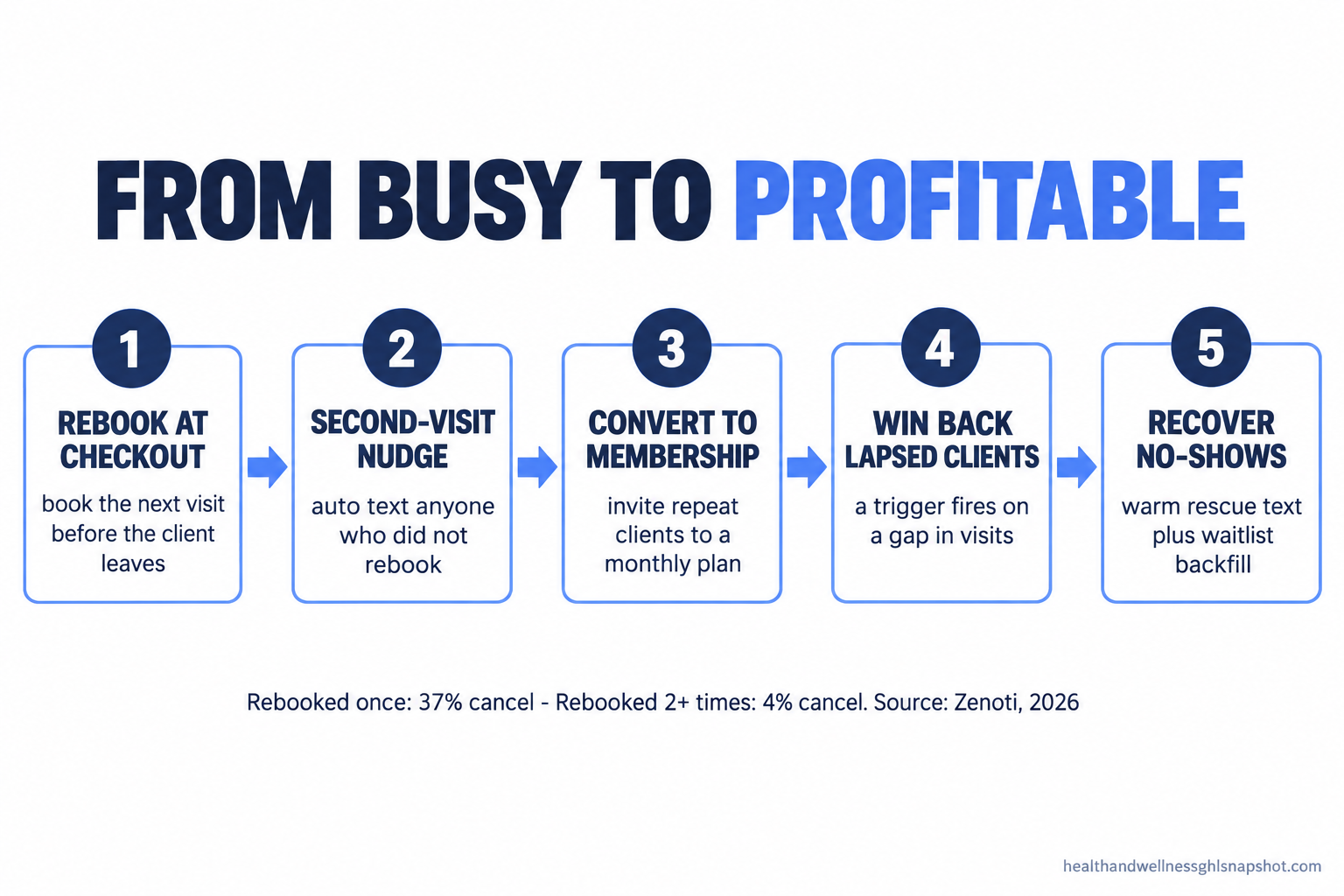
You do not fix revenue per hour with willpower. You fix it with a few messages that fire on their own. Here is the exact copy for the moments that matter most, the ones a busy front desk skips first. Lift them, change the names, and make them automatic. In the SMS examples, the words in braces are merge fields your system fills in.
Step 1: Rebook at checkout, every time
The next appointment belongs on the calendar before the card is put away. Make it a scripted step at the desk, backed by an automatic follow-up for anyone who still leaves without booking. This is the single step that moves a client from the 37% cancel tier toward the 4% tier (Zenoti).
Step 2: The second-visit nudge
The second visit is where a client becomes a client. For anyone who had a first visit and did not rebook, a short, warm nudge a few days later catches them while the experience is fresh and the drift has not set in yet.
Step 3: The membership offer
Make the offer to the clients already acting like members. When someone hits their third visit in a quarter, they have shown you they belong on a plan. That is the moment to invite them, not a mass blast to your whole list.
Step 4: The lapsed-client win-back
A client with a gap in their pattern is a reminder away, not a sale away. Trigger this when someone who used to come regularly has not booked in a set window. The tone is warm and specific, never a guilt trip.
Step 5: The no-show rescue
A missed appointment is a rebook waiting to happen if you reach out fast and warm. Fire this automatically the moment a slot is logged as a no-show, assume the best, and make rebooking effortless.
The compliance rules before you automate any of this
The moment you text clients at scale, three rules apply, and this niche is watched closely. None are hard to follow. All are expensive to ignore.
SMS consent (TCPA and 10DLC). Automated rebooking and win-back texts are business messaging. US carriers route them through A2P 10DLC brand and campaign registration, and health-related messaging is filtered more heavily than retail, so registration matters more here than in most industries. Capture explicit opt-in when someone books, keep a clear opt-out in every message, and honor STOP immediately. Our HIPAA-aware SMS guide covers the consent language in detail.
HIPAA, kept honest. If you bill insurance or share information with covered partners like labs or referring physicians, you are a covered entity and your messaging has to be handled accordingly. A pure cash-pay IV bar may sit outside HIPAA but still owes state privacy and breach-notification duties, so never assume the exemption. Keep automated texts about logistics, the appointment, the time, the rebook, not clinical detail.
FTC health claims. Your rebooking and membership copy is marketing, and the FTC has warned roughly 700 weight-loss and wellness marketers and sent letters to IV-therapy companies over immune and similar claims. Keep the copy about the visit and the convenience, not promises like “boosts immunity” or “melts fat” that you would have to substantiate with competent and reliable evidence. We cover the current rules in the 2026 FTC health-claims guide.
Common objections, answered honestly
“I don’t need more systems, I need more clients.” Maybe, but look at the leak first. New guest visits fell 11% across med spas in 2025 (Zenoti), so new clients are getting harder and more expensive to find for everyone. The cheapest revenue in your building is the client who already came once. Plugging the leaks lifts revenue per booked hour without spending a dollar more on ads, and it makes every future ad dollar work harder because the clients it brings in actually repeat.
“Won’t all these texts annoy my clients?” Only if you write them coldly or send too many. The copy above uses first names, sounds human, and always offers a real person and an easy out. A client does not experience a timely, friendly “want me to hold your next spot?” as spam. They experience it as a clinic that is organized and makes their life easier. The annoying version is the one that forgets them entirely and then blasts a discount when it gets slow.
“I already pay for Boulevard, Jane, or Mangomint. Doesn’t it handle this?” Your booking software sends reminders and takes payments. What it usually does not do is run the full revenue system, a scripted rebook-at-checkout with an automatic catch for the ones who slip, a membership flow, a visit-gap reactivation trigger, and a warm no-show rescue. Those are retention jobs, not scheduling jobs. We compare the clinical platforms in Boulevard vs Mangomint and the wider market in what med spa software actually costs.
“Do I need to be technical to run this?” No. The workflows get built once, correctly, then they run on their own. Your daily job becomes glancing at who is confirmed and replying to the handful of conversations that need a human. The build is the technical part, and it is a one-time job, not a new thing on your plate.
Frequently asked questions
Why is my wellness clinic busy but not profitable?
Because being booked measures your hours, not your money. Profit comes from revenue per booked hour and how many clients return, and a packed schedule can be full of low-ticket one-and-done visits, free consults that don't convert, discounts, and no-shows you prepped for. In 2025 the industry saw same-location revenue grow just 2% even as clinics stayed busy, with almost all growth coming from new locations opening. The fix is usually to plug the six revenue leaks in the schedule you already have, not to add more marketing.
What is revenue per booked hour and why does it matter more than being busy?
Revenue per booked hour is what each filled slot actually earns after you subtract comped consults, discounts, wasted prepped supplies, and slots that never repeat. It matters more than a full board because two identical-looking schedules can earn very different amounts depending on average ticket and repeat rate. A clinic can raise revenue without seeing a single extra client simply by lifting the value and repeat rate of the hours it already runs.
How much does it cost me when a new client never comes back?
More than the one visit you collected. You paid the full acquisition cost, the ad, referral, or front-desk time, and recovered a single ticket against it, so a first visit only turns into profit when it repeats. Since about 73% of med spa visits are repeat visits, the model depends on the second and third appointment. A one-and-done client is the most expensive kind of visit you can run.
Does rebooking really change retention that much?
Yes. Zenoti's 2026 medspa benchmark found guests rebooked only once still cancel 37% of the time, while guests rebooked twice or more cancel at just 4%. The habit of returning forms on the second and third visit, so the single most effective moment to protect your revenue is booking the next appointment at checkout, backed by an automatic follow-up for anyone who leaves without one.
Do I need expensive software to add a clinic membership?
No. The common assumption that a membership requires a $300-a-month add-on keeps a lot of clinics from launching one, but you can run recurring billing and member benefits cleanly on tools you likely already pay for. Membership is the clearest growth trend in the category, with sales up 13% year over year, because it turns your best clients into predictable monthly revenue instead of a board you rebuild from zero each month.
Will automated rebooking and win-back texts violate HIPAA or TCPA?
Not if you set them up correctly. Capture explicit SMS opt-in at booking, register for A2P 10DLC, keep a clear opt-out and honor STOP, and keep messages about logistics rather than clinical detail. If you bill insurance or share data with covered partners you are a covered entity under HIPAA; a pure cash-pay clinic may sit outside it but still owes state privacy duties, so never assume the exemption. Keep marketing copy free of health claims the FTC would make you substantiate.
I feel like I need more clients, not more systems. Which is right?
Check the leak before you spend. New guest visits fell 11% across med spas in 2025, so new clients are harder and costlier to win for everyone, while the client who already visited once is the cheapest revenue you have. Plugging the leaks raises revenue per booked hour with no extra ad spend and makes future marketing pay off better, because the clients it brings in actually come back. More clients into a leaky schedule just fills a bigger bucket with the same hole in the bottom.
Picture that same Saturday run differently. The 28 clients still come, but this time every one of them left with their next visit on the calendar, and the three who slipped out without booking got a friendly nudge by Tuesday. Two first-timers from last week came back for visit two because a text caught them while it was fresh. A regular who had gone quiet for six weeks is back in the chair because the system noticed the gap before you did. The one no-show rebooked from an automatic rescue, and the slot backfilled from your waitlist. You worked exactly as hard. The deposit report at close is finally the number a day that busy should produce. That is the whole difference between busy and profitable, and it is not more hustle. It is a schedule that pays for every hour you already work.
Keep reading: Why IV therapy clients only come once · Turn one-time IV clients into members · What no-shows actually cost a wellness clinic · Client reactivation and win-back · Run a membership without the add-on
This article is for general informational purposes and is not legal, medical, tax, or compliance advice. Statistics are as published or reported at the time of writing and change frequently; confirm the current figure on each source’s own page before relying on it. Each practice is responsible for its own HIPAA, TCPA, FTC, and state privacy obligations.